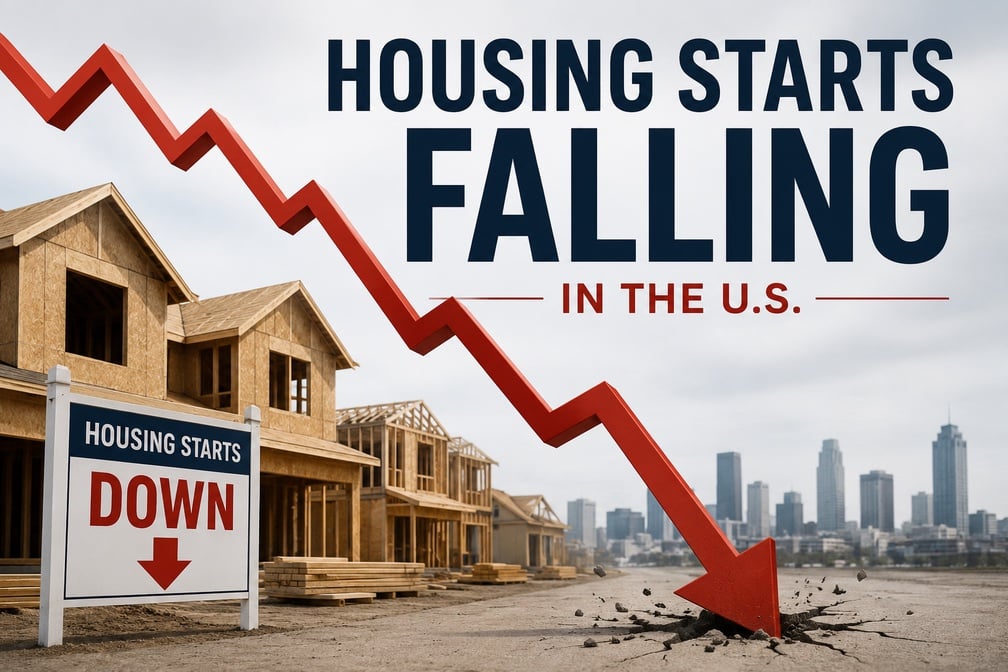
If you want to understand the future of American housing, start by picturing a market that’s toppled over and despite a few heroic efforts just can’t seem to get back on its feet. U.S. housing starts have fallen for four straight years, and even after the shock of the pandemic, they’re still stuck on the floor. The May 2026 data only hammered the point home: the country isn’t building enough homes, and that’s going to define who can afford to live where for years to come.
The Triple Knockdown
It’s not just one thing keeping new construction down. The market is caught in a vice grip; squeezed by high mortgage rates, runaway construction costs, and collapsing affordability.
First, there’s the interest rate gut punch. Mortgage rates have jumped from around 3% in 2021 into the 6–8% range and have stayed there since 2022. That’s not a minor speed bump. The Federal Reserve’s rapid rate hikes cooled inflation but also slammed the brakes on buyer purchasing power and builder financing. Housing is a slow-moving business; shocks like this last for years.
Then there’s the cost of simply building a home. What started as COVID supply chain chaos has turned into a tangle of tariffs, labor shortages, and higher insurance premiums. Concrete, lumber, even the land itself are all pricier than ever. Builders are stuck in a bind: either raise prices (and lose buyers) or eat the costs (and lose money).
And the result? Affordability has collapsed. Harvard’s Joint Center for Housing Studies now says the income needed to buy a median-priced home has nearly doubled since 2020. For millions, that means the goal of homeownership isn’t just delayed, it’s becoming unachievable.
Why May’s Fall Seemed So Bruising
May’s housing start data was a gut-wrenching headline. Total starts collapsed by 15.4%, dropping to their lowest since the early pandemic days. But there’s nuance to that story.
Multifamily construction (apartments and condos) took the brunt of it, plunging 41.6% in a single month. Developers are hitting the brakes, spooked by both higher financing costs and a sudden glut of empty units. Multifamily stats are always volatile, but this is a wipeout even by those standards.
Single-family starts slipped just 1.9%. That’s not nothing, it’s an eight-month low, but it’s more of a stumble than a collapse. Builders are hanging on, using incentives and mortgage rate buydowns to keep buyers interested, even as many hoped 2026 would bring some rate relief. Instead, rates jumped, and so did uncertainty.
This Isn’t Just A One Month Slip
It’s tempting to blame the headlines on a single, ugly data release. But this is a trend: four years of falling housing starts, and no sign of a rebound. Builders are still working through inventory they cranked out during the post-pandemic boom. They’re cautious, waiting for the numbers to make sense again.
All the while, every home not started today is one less home for sale next year or the year after.
The Supply-Demand Paradox
There’s the kicker: housing starts aren’t just a statistic, they’re tomorrow’s inventory. When new construction dries up, the market gets even tighter. We’re caught in a vicious cycle: the same forces that make housing unaffordable, like high rates, high costs, and labor shortages, are also preventing the new construction that might ease the pain. It’s a supply-and-demand paradox: the harder it gets to build, the harder it gets to buy.
The numbers are grim. About 75% of homes are now considered unaffordable for the typical American household, with buyers spending an average 42% of their income on housing. The country is short more than 7 million affordable rental units. A result of chronic underbuilding. Housing starts aren’t falling because America suddenly has enough supply. It’s because builders can’t profitably deliver homes at prices buyers can afford.
Can Housing Starts Regain Their Footing?
Unlikely in the near future. The market has been knocked down by forces outside builders’ control. Until rates, costs, and labor start to move in the right direction, the recovery will be slow and uneven, or non-existent.
Every month that housing starts “can’t get up” makes the next chapter of housing affordability that much harder to write. If the root causes aren’t corrected, we’ll be living with the consequences for years, even a decade or more.
Sources
- U.S. Census Bureau and U.S. Department of Housing and Urban Development. “New Residential Construction, May 2026.” Monthly construction data covering housing starts, building permits and completions, including the sharp May decline in multifamily construction.
https://www.census.gov/construction/nrc/ - Joint Center for Housing Studies of Harvard University. “Lower Interest Rates Fail to Offset Effects of High Home Prices,” October 28, 2025. Analysis of the sharp increase since 2020 in the income and monthly payment required to afford a median-priced U.S. home.
https://www.jchs.harvard.edu/blog/lower-interest-rates-fail-offset-effects-high-home-prices - National Association of Home Builders. Housing-market and builder research addressing construction costs, financing conditions, labor and material constraints, regulatory costs and the continuing housing-supply shortage.
https://www.nahb.org/news-and-economics - Bankrate. “Priced Out of 75% of the Market, Americans’ Dream of Homeownership Has Become a Luxury,” December 8, 2025. Analysis finding that more than 75% of U.S. homes on the market were unaffordable to a household earning the median income, with a substantial gap between typical household income and the income required to afford a median-priced home.
https://www.bankrate.com/mortgages/american-dream-of-homeownership-turning-into-luxury/ - National Low Income Housing Coalition. “The Gap 2026: A Shortage of Affordable Homes,” March 2026. National analysis finding a shortage of 7.2 million affordable and available rental homes for extremely low-income renter households, with only 35 affordable and available homes for every 100 such households.
https://nlihc.org/gap
Disclaimer: The information provided on this site is for general informational and educational purposes only and does not constitute professional real estate, legal, or financial advice. While we strive to keep information accurate and up-to-date, topic details, property details, market conditions, prices, and availability are deemed reliable but not guaranteed. Readers should conduct their own independent due diligence and consult with a licensed real estate broker, attorney, CPA, financial advisor or appropriate District of Columbia government agency to verify information and policy. Content subject to change without notice. realestateinthedistrict.com and dcrealestate.channel, their owners, operators and writers disclaim any liability for any loss or damage-arising directly or indirectly from the use of or reliance on any information provided on this blog. This blog and its affiliated social media channels are the sole property and responsibility of their owner, and are not affiliated with Compass International Holdings (CIH).