The Impact Of Job Losses And Tariffs On DC’s Real Estate Market
The U.S. real estate market is no stranger to economic fluctuations, but the latest tariff hikes, job losses and economic market volatility are combining to create a new set of challenges. Homebuyers and sellers, builders, investors, and policymakers are scrambling to adjust. The spring real estate market will reveal which markets are adapting successfully and which are struggling under mounting pressure.
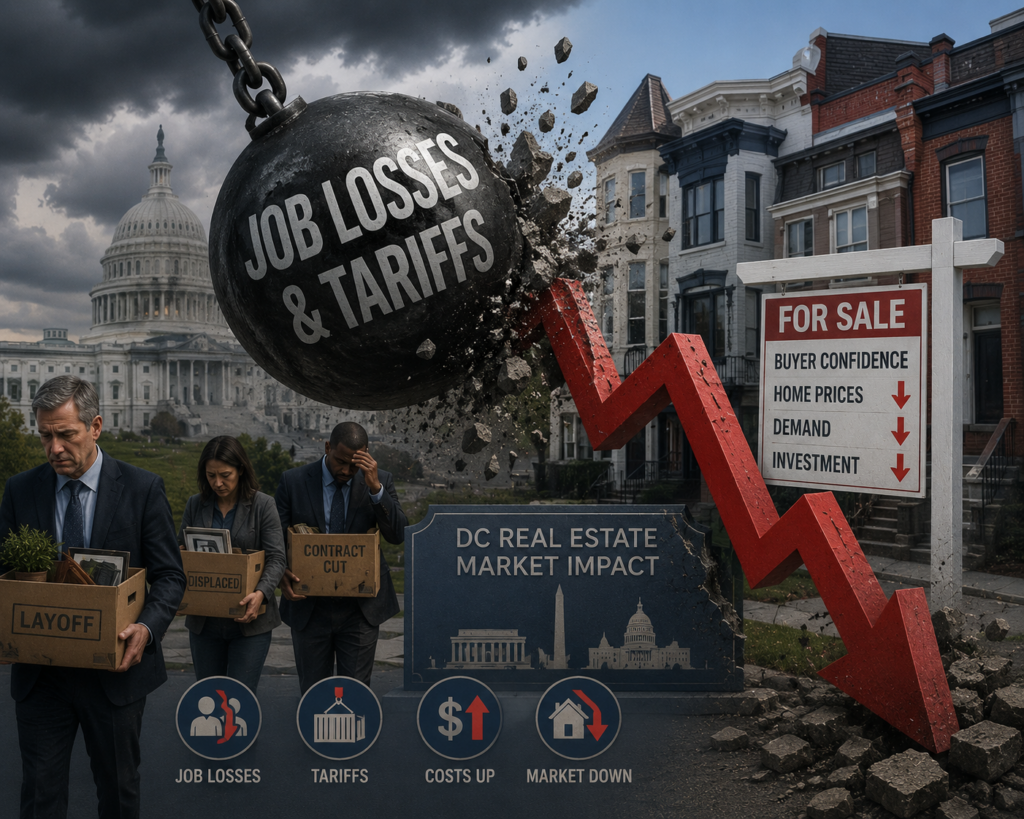
In Washington,DC, the impact of federal workforce reductions, tariffs, and other influences will test the stability of one of the nation’s consistently high-performing markets.
How Tariffs Are Impacting New Construction
When tariffs increase, construction costs rise accordingly. The question “will increases be passed on to consumers?” is not one of ‘if,’ but of ‘when.’ Developers can absorb some short-term loss, prevent it altogether by purchasing before tariffs are implemented, or find alternate sources for materials to skirt tariffs. But if tariffs are ongoing, consumers will feel the impact.
Trump’s 25% tariffs on Canadian and Mexican imports and an additional 10% tariff on Chinese goods were delayed from January, giving homebuilders the opportunity to purchase ahead of tariff implementation, or find other sources for materials. So there shouldn’t be a significant impact felt by housing consumers in the very short term. But if tariffs wars continue, that is bound to change. Here’s why:
CNBC reports:
- Lumber, gypsum for drywall and home appliances are expected to be impacted by tariffs on Canada, Mexico and China (now taxed at 20%)
- The new tariffs could increase builder costs anywhere from $7,500 to $10,000 per home, according to the National Association of Home Builders
- The greatest impact to homebuilders will be from lumber cost increases, which are expected to total about $4,900 per home on average, according to Leading Builders of America
Homebuilders will not absorb such extensive losses. Instead, they will price them into new homes and consumers will pay.
New construction projects in early stages and those still in planning phases will quickly be impacted by ongoing tariff wars:
- Lumber Prices: Historically, tariffs on Canadian softwood lumber have added thousands to the cost of new homes
- Steel & Aluminum: Tariffs on these metals affect everything from appliances to HVAC systems
- Supply Chain Delays: Even materials not directly tariffed will see cost increases due to elevated shipping costs and supplier uncertainty.
Again, with materials becoming more expensive, homebuilders have few choices:
- Pass higher costs onto buyers, making homes even less affordable
- Eliminate buyer incentives on new construction to cover the costs
- Revise 2025-26 production plans, building fewer homes, which reduces supply and drives up resale and new construction prices for consumers
Homebuyers lose and the real estate market suffers.
The market for newly built homes has been one of few bright spots for U.S. housing over the past two years. The U.S. Census Bureau reports that approximately 683,000 new homes were sold in 2024, an increase of 2.5% from 2023, a year that ended as the worst real estate market in 30 years.
New home construction has played a pivotal role by increasing inventory levels, which helps restrain home prices, particularly in 2024, when the industry ramped up production. Single-family home completions rose by 2.2% from 2023, and more than 1M single-family home starts were initiated, a 6.5% increase from 2023 (NAHB). This was an optimistic marker for the real estate industry as a whole, which has suffered stagnation due to lack of inventory and higher mortgage interest rates.
2025 forecasts published by Realtor.com suggested continued growth in new home construction, with plans to increase production by 13.8%, a significant step in addressing the national housing shortage, in particular affordable housing benefiting first-time homebuyers.
But with tariffs creating uncertainty around costs, pricing, supply chain and shipping, those plans may change.
The Unique Challenges Facing Washington DC
In Washington DC, which is highly dependent on federal employment, this year’s federal job cuts are creating instability in a real estate market that was, until now, slowing due to home prices, mortgage rates and economic uncertainty, but holding its own in terms of home values.
The District has proven itself to be one of the nation’s most consistent and resilient markets, but it is currently under attack at its very core: government employment.
The Federal Workforce Shrinks—And So Does DC’s Budget
According to the DC Office of the Chief Financial Officer (CFO), the city expects a $1.01 billion revenue decline through 2028 as a direct consequence of federal job reductions. With government jobs making up 25% of Washington DC’s workforce, these cuts could:
- Reduce demand for homes because fewer workers need housing
- Increase home inventory due to a potential ‘urban exodus,’ consequently creating downward pressure on prices due to weakened demand
- Lower consumer spending, affecting businesses and property values
- Increase commercial office vacancies, forcing landlords to lower rents or repurpose buildings.
These are only potential consequences. Actual impacts will depend on how city leaders respond, DC homeowners reactions to the challenges facing them; whether or not they are able to successfully transition from government jobs to positions in the private sector, how a large influx of government workers in the job market affects job seekers who were not employed by the government, and each individual’s unique circumstances and needs.
Real Estate Market Trends in Early 2025
The most interesting indicator to me is listing volume vs contract volume. As my Market Update shows, the number of DC homes for sale is rising, but contracts on homes for sale have plunged year over year:
- 359 new Active and Coming Soon listings were added to the MLS the final week of February through March 2nd
- There are currently a total of 2,268 Active and Coming Soon listings in MLS
- But only 164 contracts are pending for the same period
Year Over Year Data | February
- All Pendings (non-contingent contracts) for February 2024: 737
- All Pendings (non-contingent contracts) for February 2025: 311 (295 filtering out timeshare, mobile home, parking space, etc. sales)
- Difference: 57.8%
This suggests that more homes are coming available, but buyers are hesitant to act compared to 2023, which is not encouraging since 2023 was the worst real estate market in 30 years.
How Will The City & Real Estate Industry Adapt?
With tariffs and federal job losses threatening to simultaneouslly increase inventory and raise prices, the DC housing market must find ways to achieve balance:
Developers Could Focus on Affordability & Flexibility
- By shifting project focus to smaller (not micro), affordable homes in established locations, developers could appeal to buyers in a moderate price point. Luxury condos are oversupplied and demand is shifting toward affordable, workforce housing. Following the 2008 market crash, local developers were successful with infill projects, and that may work again
- Developers and policymakers could work together to convert empty office buildings into moderately-priced housing. Even with back-to-work requirements, DC office space is underutilized and there are federal buildings that could also become adaptive reuse projects to help fill the residential gap
- Continue to offer buyer broker compensation and closing cost incentives
City Policymakers Must Support Housing Stability
- Provide tax incentives for new housing projects: Offset rising construction costs with tax credits for affordable & workforce housing.
- Policymakers could create first-time homebuyer programs that offer downpayment assistance and closing cost help for moderate income buyers
- Policymakers could temporarily raise the income limits for the first-time homebuyer tax abatement program. Homebuyers who qualify are exempt from paying DC Recordation Tax at settlement, and receive an allowable credit from the seller equal to the DC Transfer Tax. Sellers reduce their transfer tax payment to DC accordingly, so there is no out-of-pocket expense for this courtesy. DC Tax Abatement participants are exempt from paying property taxes for the first 5 years of occupancy, beginning the next full tax year
- Policymakers could temporarily relax the 90 day limit on short-term rentals for federal employees who have lost their jobs
- Streamline permitting & zoning for new residential projects. Fast track Dept. of Building (DOB) permits and inspections to expedite residential conversions while maintaining building quality controls
- Attract private-sector jobs to replace federal losses. Without new job growth, housing demand will decline
Strategies for a Slower Real Estate Market
- Sellers need to price competitively. With buyers still balking at home prices in the District, pricing will be key to a timely sale
- Buyers should consult three or more lenders to understand differences in rates, programs and fees before selecting a lender
- With the CFPB sidelined, buyers should pay extra attention to risky loan programs and lending strategies that may start to permeate the market
- Buyers should stick to their budgets, avoid multiple offer scenarios and investigate DC’s homebuyer assistance programs
- Buyers can and should, in most instances, include home inspection and financing/appraisal contingencies in their offers
- Buyers can and should, in most cases, include buyer broker compensation in their offers
- Buyers should seek properties in established neighborhoods with demonstrated long-term value
- Buyers should consider home types with attributes that garner higher resale values and provide the ability to retain the property as an investment asset
What Happens If The DC Market Fails To Adapt?
The Washington DC housing market has survived recessions, workforce reductions, government shutdowns, threats against Home Rule, and political upheaval before. But this time, things feel different. What happens if the District doesn’t successfully adapt?
- Developers will slow down new projects, potentially putting upward pressure on resale home prices (depending on demand)
Federal job losses aren’t offset and reduce housing demand, leading to stagnant sales - Stagnant sales prompt sellers to withhold listings, creating inventory shortages
- If these trends continue, DC could see long-term stagnation, with high prices but low demand; a worst-case scenario for buyers and sellers alike.
Wrapping Up
Government job losses, tariffs, threats to leadership, services and Home Rule as well as economic uncertainty are bound to reshape the DC real estate market. But with key adjustments, the market may find new opportunities amid these challenges. Whether through policy changes, investment strategies, or adaptive reuse of commercial properties, D.C.’s real estate market has a chance to evolve and thrive in the years ahead.
Need Help With Your Strategy?
No one knows with 100% certainty how the DC real estate market will respond to everything being thrown at it this spring. But having a plan in place, understanding your options and available strategies is key to not just surviving, but thriving.
If you are planning to purchase a home in the near future in the District or northern Virginia, get in touch and let’s discuss your needs.
If you have a DC home to sell or you’ve lost your government job and need to know what options work best in the current market, let’s talk. I’m happy to help with a game plan and if you decide to list your home, I’ll help you price and present it to its best advantage.