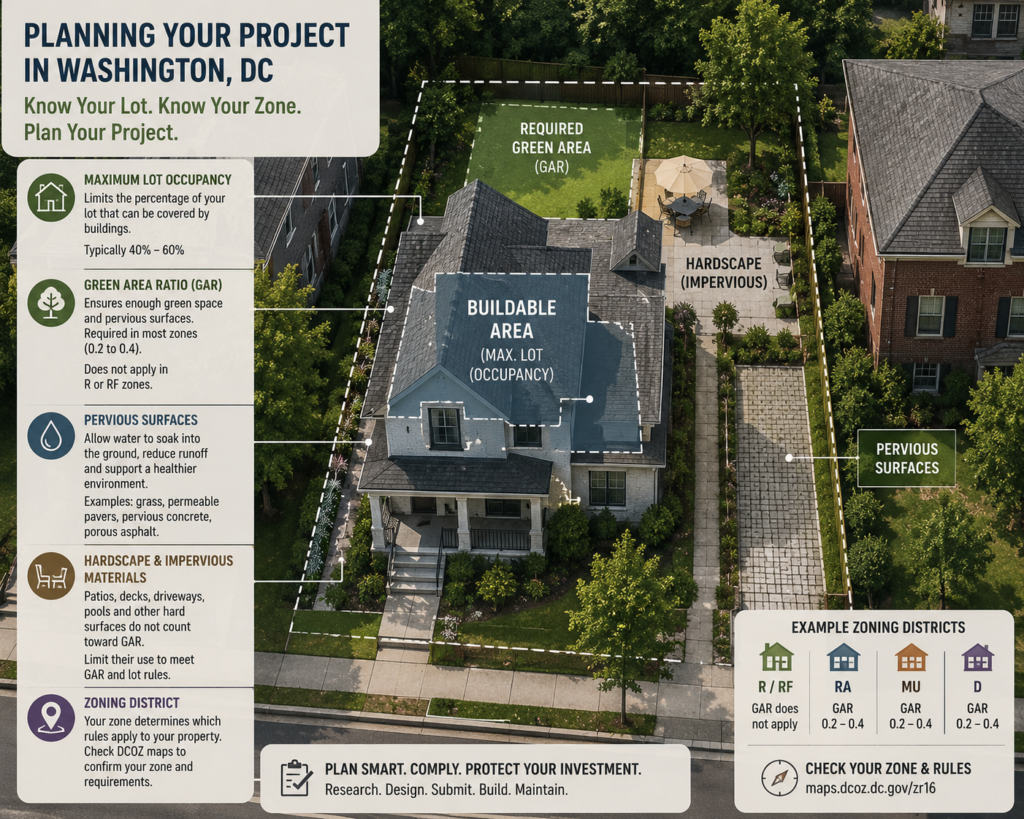
DC Building Lot Occupancy + GAR
In Washington DC, residential zones restrict the building percentage of your lot in a number of ways. Here’s what they are:
Maximum Lot Occupancy
This is the percentage of your property that can be covered by buildings. It is typically 40% – 60%.
Research the MLO of your property on DCOZ here by inputting your address. The min. and max. lot occupancy requirements will be listed in addition to other valuable information such as building restrictions.
MLO allows for light, air movement and pervious surfaces. ‘Pervious’ means that water can pass through the surface material into the ground. The water passing through these surfaces not only reduces runoff, but filter pollutants and recharge the water table. When we think of pervious surfaces, we often think of grass or plants, but many manmade surfaces can also be pervious:
- Pervious concrete: A special type of concrete that allows water seepage
- Porous asphalt: A type of asphalt that allows water seepage
- Open joint pavers: A type of paver for walkways and driveways that allows water seepage
- Interlocking concrete: Another type of paver that allows water seepage
- Plastic or concrete grid systems: Another type of paver that allows water seepage
- Permeable clay pavers: An unsealed clay paver that allows water seepage
- Porous turf: A type of permeable pavement
Green Area Ratio
DC Municipal Regulations define GAR in sec. 600.1, as “the ratio of the weighted value of landscape elements to land area.”
GAR restrictions apply when you are renovating a home’s interior, adding on to the home, or adding another building to the property.
If your property is located in an R or RF zone, GAR doesn’t apply. You can refer to the DC Zoning Handbook for more information on neighborhood zones and zoning maps.
If your project is not in an R or RF zone, you will need to meet a Green Area Ratio (GAR) somewhere between 0.2 to 0.4, depending on the zone.
Hardscape & Impervious Materials
Hardscape refers to solid surfaces that are not included in living space. Examples would be patios, decks and decking, pools, landscape walls and pavers. These materials are often impervious.
Research shows that extensive use of hardscape surfaces in urban areas can raise ambient temperatures above the norm of the surrounding region, which elevates ground-level ozone production, triggering air quality issues. It also has the effect of degrading bodies of water due to pollutants and erosion associated with increased stormwater runoff.
Research GAR, Then Plan Your Project
You can learn a lot from the GAR Guidebook published by the District. In it, you’ll find:
- The weighted score GAR assigns to development sites based on the types of landscape, site design features and the amount of area they cover
- How the minimum required GAR score differs by zoning district and what it is based upon
- Which sites require a Certificate of Occupancy and a submitted GAR plan
as part of the building permit application - Additional details on specific zoning language
- Plan submission guidelines
- Scoring requirements and worksheets
- Descriptions of landscape and building elements eligible for scoring credit
Achieving GAR Compliance
Here are the basics:
1. Determine your zoning district and required GAR score for the project
2. Use the GAR Scoresheet (see the guidebook) to calculate the total area of landscape elements necessary to achieve that score
3. Developing a design that achieves the minimum required GAR score, then submit the required GAR documentation as part of your building permit application
4. Construct and maintain the project according to the approved plans.
But Wait, There’s More!
Learn about stackable elements, green vegetation roofs, stormwater overlap and other elements of GAR in the DOEE’s Administration of GAR guide.
If all this is breaking your brain, or you simply don’t have the time to read the guides and develop a plan that complies, hire a landscape architect to work with your architect.
Which Zone Am I In?
In DC, zoning is categorized into Residential (R), Residential Flats (RF), Residential Apartments (RA), Mixed Use (MU), and Downtown (D) zones, with overlays customizing zones for specific neighborhoods.
Check your zone and corresponding rules with the zoning maps available on the DCOZ site.
The official interactive DC Zoning Map is updated daily to ensure consistency with zone changes and other real property data. Static PDF extracts of the Official Zoning Map are updated quarterly.
- Interactive Official Zoning Map.
- PDF summary extracts of the zoning map available at the District, Ward, and ANC level
Great Resource
I love the Novel Gardner’s DC Zoning Guide For Landscape Design. Published in two parts by Sandbox Land Studio, this guide provides a lot of practical detail and is a worthwhile read.
Good luck with your project and, as always, reach out if you’re interested in representation for the purchase or sale of DC real estate.
Disclaimer: This post is offered for informational purposes only and should not be construed as financial or legal advice, design or construction advice. Home buyers and sellers must always perform their won due diligence and seek counsel from licensed professionals such as CPAs and attorneys when making choices relating to a real estate transaction. We do not endorse individual service providers and citations should not be considered endorsements.