Privatizing Fannie And Freddie Means Big Profits For Wall Street, Higher Mortgage Fees And Risk For Consumers
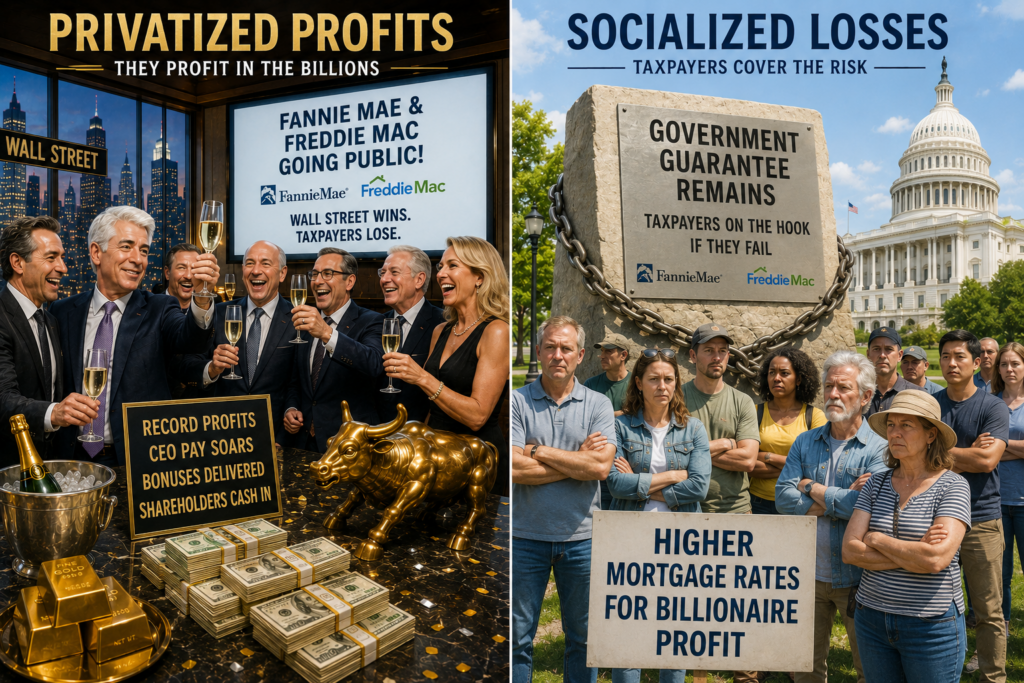
Plans to extricate GSEs Fannie Mae and Freddie Mac from conservatorship have resurfaced with the second Trump administration. The methods and merits are being debated. But let’s cut to the chase: Is there an upside for consumers? Or will this be a case of privatized profits and socialized losses?
The Promise
Trump has promised to privatize Fannie Mae and Freddie Mac. Not because it would be beneficial for consumers, but because it would benefit those who put him back in the White House, infuse approximately $270 billion in revenue help offset his TCJA extension, and constitute a key political victory. Privatizing the GSEs was touted as a way to “deliver a win for President Trump,” according to a memo circulated in late 2024 among members of the transition team and Congress, according to the Wall Street Journal.
The Challenge
Trump’s first-term attempt at the failed due to difficulties in overcoming complex requirement hurdles, and his loss in the 2020 election ended the effort. Treasury Secretary Steven Mnuchin rebuffed last-ditch tactics suggested by Mark Calabria, Trump’s first-term FHFA director, saying that steps were needed to allow the companies to build capital to absorb future losses and eventually raise money from new, third-party investors; “The real issue is how do you get them out of conservatorship? “ he said. “You need to raise third-party capital and you need to retain capital. That’s, to me, the issue.”
Now the administration is trying again. This time they have a plan and a determined team that will execute on behalf of Trump, a select number of hedge funds, and a handful of billionaire investors who stand to profit handsomely from GSE privatization.
The challenge is getting the deed done without becoming mired in Congressional quicksand, and selling a deal that is almost certainly not in their best interests to mortgage product consumers and taxpayers.
The Stakes
Fannie Mae and Freddie Mac shares generated little interest on Wall Street until last November. Between election night and mid-January, Fannie Mae’s shares rose more than 300%. YTD as of February, Fannie Mae was up about 400% and Freddie Mac 500%, with Freddie’s share price surpassing Fannie’s for the first time ever.
Key Players
Scott Turner
A former football player and head of Trump’s 2019 Opportunity Zone project, Turner was selected to lead the Department of Housing and Urban Development (HUD) and act as “quarterback” to help get privatization across the goal line. He immediately gutted the agency, and said a cross-government effort to privatize Fannie Mae and Freddie Mac will be a priority.
HUD oversees the Federal Housing Administration. While publicy claiming to focus on affordability of home ownership for Americans, Turner cut staff, budgets and programs related to affordable housing.
Bill Ackman
Billionaire hedge fund manager and CEO of Pershing Square Capital Management, Ackman backed Trump for re-election to the tune of $277 Million. What does he expect for his investment? A cool $1 Billion in profit when Fannie and Freddie are privatized. Pershing holds a 10% stake in the GSEs and stands to make as much as $1B on share values, a $1,200% profit.
Scott Bessent
Prior to his appointment as Secretary of the Treasury, Bessent was a hedge fund manager (Key Square Group), and, early in his career as a PM at the Quantum fund, he participated in the 1992 “Black Wednesday” stock bet that “broke” the Bank of England, triggering an economic and political crisis in Britain, causing interest rates to spike to 15%. Not only did his reasearch convince the fund officers to make the trade, Bessent pushed them to go further as the destruction was underway, showing his willingness to put profit over people.
Bill Pulte
The FHFA, as conservator and regulator, has broad discretion to oversee the GSEs as it sees fit. Trump appointee, billionaire Bill Pulte (CEO of the private equity firm Pulte Capital Partners, fmr director PulteGroup Inc homebuilders, questionable social media “philanthropist” and investor in grabagun.com an online gun dealer that sells, among other things, AR-15 rifles for “$500. or less” and “bulk ammo”), was handed leadership of the agency with a clear mandate to end conservatorship and privatize Fannie and Freddie. Pulte spoke about it as a priority.
John Paulson, billionaire who managed a hedge fund that reaped billions shorting the mortgage sector. Paulson raised $50M for Trump’s 2024 campaign. Paulson has invested in preferred stock Fannie Mae and Freddie Mac and advocated for their privatization.
Paulson was also an investor in the purchase of IndyMac, a major subprime mortgage lender that played a key role in the 2008 housing crisis.
In 2009, IMB Holdco, a private equity investor group comprised of Steven Mnuchin (Dune Capital Management LP), billionaires Christopher Flowers, John Paulson, Michael Dell (MSD Capital LP), and George Soros, for $13.65 billion from the FDIC. The bank was run under the name OneWest Bank Group LLC, a thrift holding company created for the purpose. The IndyMac sale included 33 branches, a reverse-mortgage unit and $176B residential mortgage servicing portfolio.
OneWest Bank ceased originations for reverse mortgages before it was acquired by CIT, but continued servicing its portfolio of reverse mortgages, and was criticized for abusive foreclosure practices. The New York Daily News and the Wall Street Journal reported that OneWest Bank had started foreclosure proceedings on 137,000 homeowners. On November 25, 2009, Judge Jeffrey Spinner in Long Island, NY, penalized OneWest for their “harsh, repugnant, shocking and repulsive” actions in trying to work out a distressed mortgage, and canceled the borrower’s debt. A year later, an appellate court overruled that the decision. On December 8, 2009, OneWest worked with the Hennepin County, MN Sheriff’s department to change the locks on a distressed home despite stating in a Nov. 25 e-mail that they were rescinding both the foreclosure and the sheriff’s sale. Changing the locks was done without a court action, bypassing mandated due process on home foreclosures in Minnesota. In May 2017, CIT agreed to pay $89M in settlement claims related to OneWest’s reverse mortgage program. In July 2014, OneWest Bank and CIT Group announced a merger. CIT Group had accepted $2.3 billion in Troubled Asset Relief Program funding that it never repaid, because it declared bankruptcy. Nonprofits raised concerns about the merger, citing the damage caused by OneWest’s approximately 36,000 foreclosures in California, the bank’s weak record in small business lending, weak Community Reinvestment Act record, and concerns about possible redlining. On August 3, 2015, CIT Group acquired OneWest Bank, N.A. In January 2022, CIT was acquired by First Citizens BancShares.
Paulson has strongly advocated for the privatization of Fannie Mae and Freddie Mac, and has claimed in the past that Congress thwarted his privatization plans.
Major Shareholders | Fannie Mae
Pershing Square Capital Management and Garde Capital, Inc. are among the hedge funds and private equity investors that hold significant shares in Fannie Mae and Freddie Mac.
- Hedge funds
Pershing Square Capital Management
Growth Fund of America
Delaware Healthcare Fund
- Private equity investors
Garde Capital, Inc. Institutional holder
Pinnacle Holdings, LLC: Institutional holder
GoodHaven Fund: Shareholder
Camelot Event Driven Fund: Shareholder
Cladis Investment Advisory, LLC: Shareholder
Wesbanco Bank Inc: Institutional holder
Kingswood Wealth Advisors, Llc: Institutional holder
Major Shareholders Freddie Mac
Pinnacle Holdings LLC
Pinnacle Financial Partners is also an approved lender of Freddie Mac’s Small Balance Loan Program
BlackRock
BlackRock has significant investments in mortgage-backed securities issued by Freddie Mac. As a major asset manager, the firm holds a substantial amount of Freddie Mac’s debt in its investment portfolios. Additionally, some former BlackRock executives have taken leadership roles at Freddie Mac, further connecting the two entities.
The largest institutional shareholders of BlackRock are Vanguard Group, BlackRock Inc., State Street Corp, Bank of America, and Temasek Holdings. The largest individual shareholders are Susan Wagner, Laurence Fink, Robert Kapito, J. Richard Kushel, and Murry Gerber.
In 2017, BlackRock released a white paper cautioning against the hedge fund supported “recap and release” proposal for Fannie Mae and Freddie Mac, saying it was a mistake to give up federal control before changing the housing finance system. The paper stated concerns about risks to the stability of the housing market and the potential for increased volatility. Instead, BlackRock authors suggested that the housing finance system undergo fundamental changes to ensure long-term stability and resilience.
“Recap and release” was supported by a familiar group of hedge fund heavyweights; Bill Ackman, Bruce Berkowitz, Richard Perry and John Paulson.
BlackRock has been out of the good graces of Republicans in recent years for its ties to the Obama and Biden administrations and participation in ESG investing. But since its two-year reduction in ESG participation and 2025 acquisition of critical ports on both sides of the Panama Canal, Republicans are said to be reconsidering its status.
Others
- PP-Asset Management GmbH (Philip Pels)
- Oberbanscheidt & Cie
- Kingswood Wealth Advisors, LLC
- Hantz Financial Services, Inc.
- Opus Capital Group, LLC
- McIntyre Freedman & Flynn Investment Advisers Inc.
- Tucker Asset Management LLC (Karlan Tucker)
- Ancora Advisors, LLC (Ancora Group, Fred DiSanto)
- Ameriflex Group, Inc.
- Growth Fund Of America (managed by Capital Group)
- SmallCap World Fund Inc (managed by Capital Group)
- Macquarie Healthcare Fund
The Plan
The plan is already underway.
The U.S. Department of the Treasury headed by Bessent, and the Federal Housing Finance Agency (FHFA) under an acting director, announced an agreement in early January 2025 to amend the Preferred Stock Purchase Agreements (PSPAs) between Treasury, Fannie Mae, and Freddie Mac (the GSEs). Provisions restricting the GSEs’ acquisition of certain loan types were removed. The agreement also contains Restoration of Consent Rights, which removes the restrictions that previously prevented the GSEs from issuing new stock, or making possible a public offering or private placement. These actions signal to investors that the companies will be able to raise capital, setting the stage for a stock offering.
In recent days, those navigating the steps towards ending conservatorship and privatizing Fannie Mae and Freddie Mac have framed their slow roll as consideration for consumers, but it’s actually due to the time recapitalization and the administrative process takes–or finding a plausible way around it. The Trump administration is well aware that any controversial move involving the GSEs could quickly become a political hot potato.
The Process
The GSEs must comply with capital requirements set by the FHFA to maintain financial stability, and the Treasury must consent before conservatorship can be terminated, obviously not an issue given changes in leadership, but that does include formulation of a structured process designed for minimal market disruption. Experts say this would require extensive financial and market impact analysis. The 2025 agreement includes a new commitment to conduct a market impact assessment prior to releasing the GSEs. The process must also include public comment periods and input from the Financial Stability Oversight Council. These provisions all extend the conservatorship termination timeline.
Prescribed Steps
- Recapitalization: The GSEs build up their capital reserves to withstand potential future losses
- Scaling Back Government Support: The government would need to reduce its involvement in the GSEs, potentially including ending the conservatorship and removing the Treasury’s preferred stock position
- Addressing Treasury’s Preferred Stock: The GSEs would need to address the Treasury’s preferred stock position, which currently has a value of close to $340 billion
- Initial Public Offering (IPO): The GSEs could potentially raise capital through an IPO, allowing private investors to buy shares
- Public Comment and Government Involvement: The roadmap for privatization would require the federal government to gather public comment before making any moves, and the Treasury would be involved
- Legal and Regulatory Framework: The process would likely involve amending or enacting new legislation to formalize the privatization process and ensure a smooth transition
- Coordination with Multiple Parties: The process would involve multiple parties, including the Treasury, the Department of Justice, FHFA, and shareholders in the private sector
- Legislative Changes: Republicans have historically slim majority in the House and with the confirmation of Rep. Elise Stefanik as ambassador to the United Nations, their majority in the House will narrow to only 2 seats.
Rash attempts to capitalize on the U.S. Treasury’s GSE ownership stakes to generate near-term, non-tax revenue could have far-reaching implications on bond markets and housing stability. Making material adjustments by administrative action could lead to significant political pushback and legal hurdles. This administration is not shy about demonstrating favoritism towards those aligned with its goals, sometimes to the point of vulgarity, but a normal administration would try to avoid the appearance of favouritism towards equity holders versus consumers and taxpayers.
Political Gamesmanship
The Sovereign Wealth Fund Route
Treasury Secretary Scott Bessent recently remarked that stakes in the GSEs might feed into the sovereign wealth fund Trump proposed in February. While this would offer strategic advantages for the Trump administration, transferring the government’s stakes in Fannie and Freddie to an SWF would introduce additional risks for consumers and taxpayers:
Advantages for the Trump Administration And Cronies
- A potentially accelerated privatization pathway could streamline privatization by avoiding the complexities of a public stock offering, leveraging the SWF’s structure to gradually reduce government control while maintaining oversight and using the SWF’s investment mandate to maximize returns on the GSEs’ assets, which the Treasury estimates could grow to $1 trillion by 2040;
- The SWF could absorb the GSEs’ retained earnings (projected at $20–25B annually) to fund national priorities like infrastructure or debt reduction–or help pay for Trump’s TCJA. Politically, it aligns with Trump’s 2019 plan to privatize the GSEs and “sell government stock at a huge profit,” feathering his political cap while keeping promises to those who helped him get re-elected;
- Ending the 17-year conservatorship would eliminate regulatory inefficiencies and allow Fannie/Freddie to operate with private-sector agility, potentially boosting housing market liquidity.
The sovereign wealth fund (SWF) proposal would serve a combination of political, economic, and ideological goals for the Trump administration:
Accelerate privatization skirting congressional involvement. By shifting GSE ownership into a sovereign wealth fund, the administration can fast-track structural reform without needing legislative approval and avoiding the longstanding gridlock in Congress over housing finance reform. Trump has demonstrated his fondness for direct action in lieu of legislative action through the first two months of his administration.
Privatizing Fannie and Freddie has been a decades-long goal for many Republicans. Placing the GSEs under a sovereign fund could be framed as a fulfillment of that objective, especially if paired with regulatory rollbacks.
The move would also benefit well-positioned investors like Bill Ackman and his Pershing Square Holdings Ltd, who stands to profit significantly. Ackman backed Trump’s re-election with expectations of privatization. It would also offer significant returns for those holding preferred or common shares, turning political loyalty into financial gain.
This includes taxpayers, who, through the U.S. Treasury, hold warrants for nearly 80% of the GSEs’ common stock. If properly managed, the government’s stake would result in substantial public returns. It’s plausible that, with the right architecture, safeguards and transparency, a sovereign fund could serve as a bridge between public interest and market discipline.
The administration is likely to argue that placing Fannie and Freddie within a sovereign wealth fund (SWF) would protect consumer interests and enhance public benefit:
- If Congress requires transparency, independent audits, and oversight boards, an SWF could act as a stable public steward of the GSEs while allowing operational flexibility, though Congress has shown little to no interest in interfering with the Trump administrations actions thus far;
- Housing finance reform has stalled for over a decade. An SWF may offer a controlled interim solution, avoiding chaotic privatization while slowly shifting risk to private capital;
- If managed transparently, profits from the SWF’s GSE holdings could be earmarked for housing trust funds, infrastructure, or deficit reduction—broadening taxpayer benefit;
- Keeping the GSEs within a U.S. controlled SWF could prevent foreign capital from acquiring controlling interests during privatization, maintaining national security and policy control;
- The move could create a defensible econoic narrative, pitched as fiscally responsible, allowing the government to “harvest value” from its GSE holdings while gradually scaling back its direct market role. This narrative would be framed as a win-win for taxpayers and capital markets.
But it’s not probable. There’s a greater likelihood, given the actions of this administration thus far, that consumers of mortgage products and taxpayers will end up on the losing end.
Disadvantages for Consumers and Taxpayers
While taxpayers hold a significant stake in Fannie and Freddie through Treasury warrants, the interests of taxpayers who are also mortgage consumers are unlikely to be aligned with those of investors or government stakeholders.
- Consumers as Taxpayers: In theory, consumers benefit from potential public windfalls if Treasury monetizes its stake. However, these gains are indirect, delayed, and depend heavily on how proceeds are managed;
- Consumers as Borrowers: These same individuals may face higher mortgage rates, reduced access to credit, and a shift toward more profit-driven loan products if the GSEs operate within a SWF with profit-maximization goals;
- Risk of Political Interference: If the SWF is controlled by the executive branch, particularly under an administration prone to centralized authority and political favoritism as is the current administration, there is significant risk that the GSEs could be managed in ways that disadvantage certain groups of borrowers, whether by geography, income, ideology and/or other factors;
- Reduced government backing could increase perceived risk, leading to higher mortgage rates. Analysts warn rates might rise by 0.5–1.0 percentage points, disproportionately affecting first-time buyers;
- Sovereign wealth funds face political and economic pressures; sudden divestment by the SWF could destabilize mortgage markets. Taxpayers remain indirectly liable if SWF investments underperform, as the fund’s losses could necessitate federal bailouts;
- All taxpayers would suffer loss of transparency and accountability. Sovereign wealth funds typically operate with less public scrutiny than government agencies or regulated private companies. Their mandate is to maximize returns on invested capital. This directly conflicts with Fannie and Freddie’s mandate to provide liquidity and affordability in housing markets. Consumers could face higher mortgage rates or stricter credit access if profit becomes the dominant motive. Transferring the GSEs into a SWF would reduce Congressional and public oversight over housing policy implementation, use of funds, foreign influence and ensuring that investor interests aren’t prioritized over consumer protections;
- The move would consolidate executive authority over a vital sector of the U.S. economy, and this is a key point. Consolidation of this type circumvents traditional checks and balances, and centralizes influence over housing policy in the hands of a few with aligned interests. If managed without robust oversight on behalf of the public, it could lead to politicized allocation of credit, weakened consumer protections, and erosion of trust in what has historically been a quasi-public utility system underpinning the middle class’s access to housing;
- While the plan appears to shift the GSEs away from direct federal control, placing them under a single sovereign wealth fund does not create the kind of market-based competition that proponents of privatization argued for. Instead, it concentrates power and risk within a semi-public structure;
- If the fund holds equity in Fannie and Freddie but still expects government guarantees in a crisis, taxpayers may still bear downside risk—without receiving direct accountability or benefit. The model risks recreating the pre-2008 dynamic where profits are privatized and losses are socialized;
- Centralizing such a large segment of the housing finance market in a state-controlled investment fund could distort capital markets. The move may signal that housing finance is being treated less as a public good and more as a strategic asset to be leveraged, contributing to widening housing inequality;
- Fannie and Freddie currently retain $147B in capital (up from $23B in 2018). Diverting earnings to the SWF could slow their recapitalization, delaying full privatization by 5–7 years. The proposal, in effect, would be a form of “partial privatization” for Fannie Mae and Freddie Mac.
A sovereign wealth fund introduces long-term governance and policy risks that could compromise the affordability, accessibility, and stability of the U.S. housing market.
Partial Privatization Via SWF
Transferring the government’s stakes in Fannie and Freddie to a sovereign wealth fund (SWF) would decrease direct federal control over the GSEs.
- The plan involves raising $20-30 billion from private investors while maintaining a significant government stake through the SWF. This creates a hybrid ownership model, combining private and public interests;
- The proposal allows for a phased approach to privatization, potentially easing the transition from full government conservatorship to a more market-driven structure;
- While reducing direct control, the government would still maintain a substantial financial interest through the SWF, estimated at over $250 billion;
- Despite moving towards privatization, these entities would likely remain subject to government regulation and oversight, particularly given their critical role in the $12 trillion mortgage market.
This approach differs from full privatization by maintaining a significant government stake and influence through the SWF, while also introducing private capital and potentially more market-driven operations.
Sound good? Here’s why it’s not:
Partial privatization of Fannie Mae and Freddie Mac could have significant downsides for consumers and taxpayer stakeholders.
Higher Mortgage Rates
Consumers may face increased mortgage rates as a result of privatization. Experts warn that rates could rise by 0.5 to 1.0 percentage points, which would disproportionately affect first-time homebuyers. This increase is due to reduced government backing, which could lead to higher perceived risk in the mortgage market.
Market Volatility and Disruption
The transition to partial privatization could cause temporary disruptions in the mortgage market. Neil Shapiro, a real estate practice partner, suggests that changes in loan processes could add 45 to 90 days to multifamily loan closings, significantly delaying borrowers and causing market uncertainty.
Reduced Affordable Lending
There are concerns that privatization could reverse recent improvements in affordable lending. The GSEs might become less willing to develop flexible underwriting standards, offer mortgage products designed for lower-income families, or undertake marketing and outreach in underserved neighborhoods.
Taxpayer Risk
While the government’s stake would be reduced, taxpayers could still be indirectly liable if investments underperform or if a financial crisis occurs. The perception that the government would bail out Fannie and Freddie in a crisis might persist, potentially leading to moral hazard.
Loss of Government Revenue
The current arrangement has been profitable for the government, taxpayers and mortgage consumers. As of the third quarter of 2024, the combined net worth of Fannie Mae and Freddie Mac stood at $147 billion. Privatization could mean forfeiting this lucrative investment and its associated revenues for taxpayers.
Potential Instability in Housing Finance
The transition might lead to uncertainty in the housing finance system, potentially affecting the availability and terms of the 30-year fixed-rate mortgage, which is crucial for many homebuyers.
Regulatory Concerns
There are worries about potential “DOGE-like interventions” in reference to rapid changes and contract cancellations at federal agencies. This could lead to reduced oversight and potentially increase risks for consumers and the broader financial system.
While partial privatization might sound great in terms of reducing government involvement, it poses significant risks for consumers in terms of higher costs and reduced access to affordable mortgages, for taxpayers in terms of potential market instability and loss of government revenue, and for both in terms of transparency and fairness.
Partial Privatization Sans SWF
Fannie Mae and Freddie Mac could be released from conservatorship without being fully privatized and without transfer to a sovereign wealth fund. They could simply remain government-sponsored entities with some level of government oversight after being released from conservatorship, but… effecting partial privatization would require significant legislative changes and new regulatory frameworks to manage systemic risk in the housing market. Taxpayers would still be likely to have risk associated with an implicit or explicit guarantee.
The CBO (Congressional Budget Office) gamed out the ‘hybrid” approach in a 2010 (pre-conservatorship) exploration of options:
“Many proposals for the secondary mortgage market
involve a hybrid approach with a combination of private for-profit or nonprofit entities and federal guarantees on qualifying MBSs. At its core, the hybrid public/private approach would preserve many features of the way in which Fannie Mae and Freddie Mac have operated, with federal guarantees (combined with private capital and private mortgage insurance) protecting investors against credit risk on qualifying mortgages. However, most hybrid proposals would differ from the precrisis operations of Fannie Mae and Freddie Mac in several important ways:
- A possibly different set of private intermediaries would participate in securitizing mortgages backed by federal credit guarantees
- The guarantees would be explicit rather than implicit, and their subsidy cost would be recorded in the federal budget.
As the public-utility and competitive market-maker models illustrate, a hybrid approach could be implemented in a way that involved more or less federal regulation of participants in the secondary market and a smaller or larger number of competitors in that market.
Agreement Restoring Treasury Block
On January 2, 2025, the Treasury Department and Federal Housing Finance Agency (FHFA) announced that an agreement was struck to restore Treasury’s right to block any proposal to remove Fannie Mae and Freddie Mac from conservatorship.
In a separate side letter from FHFA to Treasury, FHFA notes that public input will be solicited regarding the potential impacts on the housing market before releasing the GSEs from conservatorship. The President would also be consulted. This could be effected via either legislatively or administratively, with the FHFA declaring the Enterprises ready for exit.
At the time the original PSPAs were executed in September 2008, written Treasury consent was required before the conservatorships could be terminated. The new amendments restored that consent right. FHFA and Treasury also agreed that the path to ending the conservatorships should be based on the financial condition of the GSEs and potential impact of termination on the housing market.
Accordingly, FHFA and Treasury agreed to a process for eventual public input on termination options and potential impacts, which is addressed in a separate side letter between the agencies.
“The Enterprises play a vital role in the national housing finance system,” then FHFA Director Sandra L. Thompson said. “Today’s announcement will reassure stakeholders that the Enterprises’ eventual release from conservatorship will follow a methodical process intended to minimize disruption to the housing and financial markets.”
The process set forth in the side letter applies to terminations other than receivership and was intended to facilitate an orderly termination of the conservatorships and to ensure that the impact of the termination on the GSEs, the housing market, and U.S. financial stability is considered.
Key terms:
- Deletion of suspended provisions. The agencies removed provisions that were suspended in September 2021
- Restoration of Treasury’s consent rights. Treasury’s right to consent to a release of the GSEs from conservatorship was reinstated Treasury now has the right to consent to any discretionary action by FHFA to commence a receivership of the GSEs
- The amendments clarify that the GSEs must meet capital requirements established by FHFA, as those rules are modified over time
- A separate side letter requires FHFA to solicit public input regarding potential impacts of releasing the GSEs from conservatorship. This process includes briefing the Financial Stability Oversight Council, and analyzing market impacts before seeking Treasury consent
- The changes provide Fannie Mae and Freddie Mac with more flexibility to support access to homeownership and rental housing
- The amendments include technical changes or clarifications that apply to the GSEs’ financial reporting.
September 2021 Provisions
In September 2021, certain rules or requirements in the agreements between the government and Fannie Mae and Freddie Mac were suspended:
The rules and requirements deleted from the Preferred Stock Purchase Agreements (PSPAs) in January 2025 were those which had been suspended in September 2021. Specifically, these included:
- Limits on the Enterprises’ cash windows (loans acquired for cash consideration)
- Restrictions on multifamily lending
- Limits on loans with higher risk characteristics
- Restrictions on second homes and investment properties
- The $80 billion annual multifamily mortgage purchase limit for each Enterprise (Fannie Mae and Freddie Mac)
- Limitations on “high-risk” mortgages, which included loans with:
- Loan-to-value (LTV) ratio above 90%
- Debt-to-income (DTI) ratio above 45%
- FICO score below 680
By deleting these suspended provisions, the government removed them permanently.
Reaction from TD Cowen’s Jaret Seiberg:
“We see this as an effort by the Democrats to ensure Donald Trump owns any negative outcome from ending the conservatorship of Fannie and Freddie as it deprives Team Trump from saying the independent regulator made the decision to proceed with recap and release.”
Reaction from Jonathan McKernan, Republican FDIC commissioner and Trump’s CFPB nominee:
The Trump administration has the power to amend or nullify the agreement. Jonathan McKernan said on X that the agreement marked a “Bad day for financial stability and protecting taxpayers against bailouts . . . even if all easily reversed.” –crefc.org
Second Lien Pilot Program
In June 2024, FHFA announced conditional approval for Freddie Mac to allow Freddie Mac to purchase second mortgages to provide homeowners with a way to tap home equity without paying high HELOC rates. Director Sandra L. Thompson said:
“The limited pilot will allow FHFA to explore whether this closed-end second mortgage product effectively advances Freddie Mac’s statutory purposes and benefits borrowers, particularly in rural and underserved communities.”
Closed-End Second Mortgages
In a housing market stressed by high mortgage rates and low housing supply, second mortgages can offer benefits for borrowers, lenders and the overall market, potentially at lower risk than alternatives such as a cash-out refinances. Freddie Mac’s limited pilot program to purchase certain single-family closed-end second mortgages is subject to the following restrictions:
- A maximum purchase volume of $2.5 billion
- Length of mortgage limited to 18 months
- Maximum loan amount of $78,277, corresponding to certain subordinate-lien loan thresholds in the CFPB’s definition of Qualified Mortgage
- A minimum seasoning period of 24 months for the first mortgage
- Eligibility for principal/primary residences only
When the pilot concludes, FHFA will analyze the data on Freddie Mac’s purchases of second mortgages to decide if the objectives of the program were met, and consider next steps.
Pilot Scope: Limited rollout starting in Q4 2024.
Critics claimed the program would encourage “equity-stripping” and add to consumer debt levels as the economy slows.
Republican Rep. French Hill said: “This pilot is just a presidential campaign-year stunt aimed at helping rich people take out home equity. FHFA should be focused on safety and soundness and building capital.”
The Housing Policy Council, a mortgage industry trade organization, says the program is not in the public interest. Politico reported that HPC President Ed DeMarco said the second-lien program, and a separate pilot by Fannie Mae to bypass title insurance on certain loans, suggest the GSEs are reverting to what he said were risky past practices:
“In some ways, it feels like it’s starting to look like it did pre-conservatorship, which is the reason this whole new product rule is in the statute — because of a lot of public concern about how Fannie and Freddie pre-conservatorship were using the benefits of their special subsidized GSE charter to get into areas that were outside of the core mission and purpose of the GSEs.”
Valuation
In January, FHFA and Treasury agreed to amend the senior preferred stock purchase agreements between the Treasury, Fannie Mae and Freddie Mac, to help facilitate their release from conservatorship.
At least one proposal circulating among members of Trump’s team in recent months estimates the privatized entities would be valued above $330 billion, with over $250 billion of that coming from the warrants’ conversion to common shares.
Fannie and Freddie would raise another $20 billion to $30 billion from new investors as part of the plan, akin to an initial public offering. A raise of that size would put it on par with the largest IPOs of all time.
Capitalization
The Enterprise Regulatory Capital Framework (ERCF) establishes several key capital requirements for Fannie Mae and Freddie Mac:
Risk-based capital requirements:
- Common Equity Tier 1 (CET1) Capital: 4.5% of risk-weighted assets
- Tier 1 Capital: 6.0% of risk-weighted assets
- Adjusted Total Capital: 8.0% of risk-weighted assets
Leverage capital requirement:
- Tier 1 Capital: At least 2.5% of adjusted total assets
Capital buffers:
- Prescribed Capital Conservation Buffer Amount (PCCBA): Includes stress capital buffer, stability capital buffer, and countercyclical capital buffer
- Prescribed Leverage Buffer Amount (PLBA): Equal to 50% of the stability capital buffer
Total capital requirement (including buffers):
- CET1 capital: 10.1% of risk-weighted assets
- Tier 1 Capital: 11.6% of risk-weighted assets
- Adjusted Total Capital: 13.6% of risk-weighted assets
It’s important to note that as of June 30, 2024, Fannie Mae and Freddie Mac’s capital levels were “significantly below the levels that will be required under the ERCF”3. The compliance date for these requirements will be the later of the termination date of conservatorship and any compliance date provided in a transition order.
The Structured Finance Association, a leading trade association representing the structured finance and securitization industry, cautioned in February 2025 that the federal government must protect financial markets from unruly disruptions in the even that it decides to withdraw Fannie Mae and Freddie Mac from conservatorship.
SFA CEO Michael Bright said;
“The private U.S. securitization market is the envy of the world. But for ‘reform’ and ‘privatization’ of GSEs to be more than buzzwords, barriers to private capital must be center stage. Otherwise GSE reform would be an accounting gimmick that would put Washington D.C., behemoths at the helm of our nation’s housing market.”
It is crucial that Trump, the FHFA, Treasury, and Congress:
(1) set up clear and stable rules under which that core mortgage businesses will operate going forward, and
(2) not produce (or appear likely to produce) a stream of unfunded mandates, taxes or other special burdens upon the GSEs that will reduce ROE below what investors require.
If these conditions, needed for the two companies to operate as reasonable commercial enterprises, are not put into place, then equity investors just won’t know enough or have the confidence to ever get comfortable with any reasonable valuation of their shares.
The Net Worth Sweep
From 2013 to 2019, nearly all profits from dividends generated by Fannie Mae and Freddie Mac under conservatorship were ‘swept’ imto the Treasury under a policy called “Net Worth Sweep.” While it ensured that taxpayers recouped losses from the GSEs’ bailout, this policy prevented the GSEs from rebuilding their equity capital once the debt was repaid.
Until 2019, when the government ended the sweep of Fannie’s and Freddie’s profits, they were leveraged about 1000-1.
Their capitalization rate has increased significantly since then:
- In September 2019, Treasury increased the capital retention limit to $25 billion for Fannie Mae and $20 billion for Freddie Mac
- As of September 30, 2020, Fannie Mae had retained equity capital of approximately $21 billion and Freddie Mac had about $14 billion
- On January 14, 2021, Treasury suspended the net worth sweep entirely until the GSEs are fully recapitalized.
By January 2025, the combined capital of Fannie Mae and Freddie Mac had grown to approximately $153 billion. This represents a substantial increase in capitalization over the 5-year period from 2019 – 25. The GSEs went from having a combined capital of about $3B in 2019 (based on the $3B net worth allowance for each GSE) to $153B in 2025, an increase of about $150B. The average annual rate of capitalization since 2019 has been approximately $30B per year.
As of January 2025,:
- Fannie Mae has an estimated $94 billion in capital
- Freddie Mac has an estimated $59 billion in capital.
What is the “Implicit Guarantee?”
The Trump administration’s intent is to end conservatorship administratively, leaving the flawed statutory framework that pushed Fannie and Freddie into conservatorship in the first place.
During Scott Bessent’s pre-confirmation hearings, Senator Elizabeth Warren asked: “During the 2008 crisis, the federal government bailed out Fannie and Freddie, vindicating widespread investor views that the GSEs were backed by an implied government guarantee despite their lack of an explicit government guarantee. If the conservatorships are ended, would you support extending a full faith and credit guarantee to Fannie and Freddie, their securities, or their debt? In your view, would doing so require congressional action or could FHFA or the Treasury extend such a guarantee through administrative action?
And; “Should Fannie and Freddie be charged a fee for any government guarantee, whether explicit or implied? If so, how much should that fee be and how would such a fee affect mortgage costs?”
Bessent answered: “It is my understanding that legislation from Congress would be required for an explicit, paid-for guarantee backed by the full faith and credit of the government. If confirmed, I look forward to being briefed on options regarding a government guarantee.”
Warren: “Because of the federal government’s bailout of Fannie and Freddie, the federal government owns senior preferred shares in the GSEs. Should American taxpayers be compensated for any reduction in their senior preferred shares?”
Bessent: “Treasury should be compensated for its past support of the GSEs, and if confirmed I look forward to exploring options for potentially dealing with this matter.”
Who Would Profit From Privatization?
Bankers, hedge funds and other investors that bought stock for pennies on the dollar immediately following the market crash would realize a substantial windfall if the organizations are privatized. Investors could sell over $100B in shares at once.
Hedge fund billionaire Bill Ackman is a vocal proponent of privatization, He recently posted on X:
“A successful emergence of Fannie and Freddie from conservatorship should generate more than $300 billion of additional profits to the Federal government while removing ~$8 trillion of liabilities from our government’s balance sheet.”
Ackman’s firm, Pershing Square Capital Mangement, holds a strong investment in both Fannie and Freddie. The increase in share values would enrich it as much as $1 billion.
As to Ackman’s claims about removing $8T in liabilites, that’s only true if implicit guarantee ends with privatization. And his claim about $300B ‘in additional profits to the Federal government’ is also misleading in that any gains would not reduce the federal deficit, but simply be shifted to offset new debt such as the $4.5 trillion Trump’s extended TCJA would cost.
The Fannie/Freddie privatization deal would be huge for shareholders and potentially for new investors.
According to the National Association of Realtors, 74% of buyers financed their home purchase in 2024, and that was during an unusual surge in cash purchases. In 2024, lenders sold $340.34 billion in single-family loans to Freddie Mac and $328.72 billion to Fannie Mae, exclusive of multifamily mortgages. Last year alone, Fannie Mae originated over $55 billion in multifamily lending, and Freddie Mac originated $66 billion. The Federal Housing Finance Agency (FHFA) set an increased volume cap of $70 billion for each agency in 2024. As of 2025, Fannie Mae and Freddie Mac support around 70% of the mortgage market. This means that most conventional loans are either purchased or backed by one of these two entities–a near monopoly.
That’s catnip to investors, if the privatized companies hold their market shares. If. And what’s likely to weaken the offering? Removing the implicit guarantee.
If Past Is Prologue…
Several wealthy investors and financial entities amassed large positions in Fannie Mae and Freddie Mac stock (common and preferred shares) in hopes of a lucrative payoff when the companies are released from government control. Here are some of the major players with stakes in the GSEs – and their ties to the Trump camp – based on filings and reports:
John Paulson (Paulson & Co.) – Billionaire hedge fund manager John Paulson’s funds acquired significant Fannie/Freddie holdings (particularly preferred shares) as a bet on privatization
Source: citizen.org
Paulson was an early Trump backer: he served as an economic adviser to Trump’s 2016 campaign and donated heavily, for example organizing a fundraiser where donors paid $250,000 each.
Additional Source: therevolvingdoorproject.org
Both Trump and Steven Mnuchin (former U.S. Treasury Secretary) had invested money in Paulson’s hedge fund prior to taking office, and stood to benefit indirectly from Paulson’s GSE bet.
Source: citizen.org
Paulson publicly pressed the new administration to privatize Fannie and Freddie, and the GSEs’ stock price surged over 80% after Trump’s election.
Source: vanityfair.com
Nonprofit consumer advocacy org Public Citizen and The Revolving Door Project joined to call upon two inspectors general to investigate potential insider trading of Fannie and Freddie stock based on Trump administration ties in February of 2014.
“The inspectors general for the U.S. Treasury Department and the Federal Housing Finance Agency (FHFA) should investigate whether federal officials leaked information about plans for government-controlled mortgage finance companies Fannie Mae and Freddie Mac with the intent to manipulate markets for the benefit of investors in preferred and common shares, Public Citizen and the Revolving Door Project said in a letter (PDF) sent to the two inspectors general today” the article reads;
“The letter highlights a dramatic move in the shares of Fannie and Freddie before and after media leaks, suggesting that the Trump administration was considering privatizing the two government-controlled companies without the consent of Congress.”
As the publication points out, Trump and (former) Treasury Secretary Steven Mnuchin had invested with John Paulson’s hedge fund, Paulson & Co., prior to assuming government roles. Paulson & Co. invested in preferred shares of Fannie Mae and Freddie Mac. As mentioned earlier in this post, Paulson was among the investors Mnuchin assembled in 2008 to buy Indymac and create OneWest Bank. Paulson bought a 24.9% stake in OneWest, making Mnuchin’s venture possible.
Trump’s Acting FHFA Director Joseph Otting (2019) was the CEO of OneWest from 2010 to 2015. Otting went on to various ventures following his stint as Trump’s Comptroller of the Currency (2017-2020), and now serves as Executive Chairman, President, and CEO of Flagstar Financial, Inc. and of its bank subsidiary, Flagstar Bank, NA. In 2022, Flagstar Bank was acquired by New York Community Bancorp (previously First Security Savings Bank) in 2022. NYCB officially rebranded to Flagstar Financial on October 25, 2024. Flagstar Bank, N.A., is a subsidiary of Flagstar Financial.
Otting and Mnuchin assumed two of the four board seats at New York Community Bank, nafter Mnuchin’s Liberty Strategic Capital group and other investors invested $1.05 billion in the institution.
This overlap of public policy and private profit is why Congress members, ethics watchdogs, and the media paid such close attention to the administration’s every move on GSE reform.
Who Would Lose?
Sales of $100B or more could destabilize the U.S. housing market, which is heavily reliant upon FHFA backing.
As Mark Zandi, chief economist at Moody’s Analyatics, told CNBC:
“If you invest in mortgage-backed securities or in Fannie Mae or Freddie Mac’s secured debt, the end of the conservatorship could bring on more risk, therefore you will demand a higher interest rate to compensate for that risk, and therefore mortgage rates will be higher as well.”
And higher rates translates to higher loan costs and payments for mortgage borrowers.
Zandi added that any release scenario could affect all parties involve, except potentially Fannie and Freddie shareholders: “They’re going to make money on the shares they own. That’s why they’re pushing for it.”
“It really ultimately depends on what President Trump wants to do or not do. Even then though, I think they’ll be repelled from actually getting it done because the economics will become apparent that this makes no sense.”
Nikitra Bailey, Executive Vice President at the National Fair Housing Alliance, stated in a February 2025 post on ; “Privatizing Fannie Mae and Freddie Mac during the nation’s fair and affordable housing crisis will drive up the cost of mortgages for all consumers. Voters want housing costs to become lower and more affordable. Privatization of the GSEs is also being pushed by the same investors who are leading the charge against the federal government’s efforts to foster diversity, equity, inclusion, and accessibility.”
Changes to the GSEs would come at a difficult time in the U.S. housing market, when many Americans are already priced out by mortgage interest rates and prices.
Many experts warn that privatization would increase mortgage rates and fees for consumers and, without clear risk accountability, eventually lead to a repeat of irresponsible and illegal behaviors that led up to the 2008 market crash:
- Private investors would seek maximum short-term profits by taking on riskier mortgages
- Wall Street and mortgage lenders might again engage in risky and questionable practices that harm borrowers and the market as a whole
- Without government regulation, borrowing costs could rise, making homeownership more expensive
- History has shown that in times of financial distress, the government is often forced to intervene, socializing the losses while private entities skipped away with the gains. Without a framework mandating that private entities must absorb their own losses, the mistakes of the past will repeat.
In short, privatization offers no upside for consumers and they would be subjected to significant risk if the GSEs were re-privatized.
A Classic Example of Privatized Profits, Socialized Losses
The suggestion of privatizing government agencies is often accompanied by promises of increased volume and profits, higher efficiency, promotion of competition, and reduced taxpayer burden. But when it comes to government sponsored enterprises Fannie Mae and Freddie Mac, profits would be privatized, and losses socialized.
What does the phrase mean? Per Investopedia, ‘Privatizing profits and socializing losses’ has a number of synonyms, including socialism for the rich, capitalism for the poor, and lemon socialism.
- Privatizing profits and socializing losses is the consequence of allowing shareholders to benefit from company earnings while making society responsible for their losses.
- Loss socialization generally refers to some type of government intervention either through bailouts or subsidies.
- Defenders of the concept of privatizing profits and socializing losses justify this practice by stating that some companies are too big to fail.
Company earnings are treated as the rightful property of shareholders–but company losses are treated as a responsibility that society must shoulder. In other words, the profitability of corporations is strictly for the benefit of their shareholders. But when the companies fail, the fallout—the losses and recovery—is the responsibility of the general public.
By privatizing Freddie Mac and Fannie Mae, liability for some 70% of the country’s conventional mortgage loans seems to shift to the private sector. But it’s really shifting to taxpayers because when greed leads to disaster, taxpayers will get the bailout bill.
The 2008 Financial Crisis was a textbook illustration of socialized losses. Fannie and Freddie expanded their exposure to risky subprime loans, chasing short-term profits, while private shareholders and executives realized huge profits. When the housing market collapsed, both GSEs faced losses so catastrophic the government was forced to place them under conservatorship and inject $191B in taxpayer funds to prevent their total collapse, which would have tanked global financial markets. Too big to fail.
The bailout stabilized the housing market, but demonstrated a key issue: while institutional and private investors and executives engaged in exorbitant spending and bad behavior while raking in the profits during the good years, taxpayers were left with the financial burden when the system failed.
About That Conservatorship
Amrerican housing finance is dominated in large part by the two housing Government-Sponsored Enterprises (GSEs), Fannie Mae and Freddie Mac, and other government guarantees supplied by the Federal Housing Administration (FHA) and its loan securitizer, Ginnie Mae. Combined, they guarantee most of all new mortgage originations.
Fannie Mae and Freddie Mac are chartered by the U.S. government to facilitate the flow of money into mortgage products through securitization:
- Purchase mortgages from lenders iand convert them into mortgage backed securities (MBS)
- Providing insurance on the credit risk of the underlying mortgages of the MBS
- Guarantee the timely payment of principal and interest on the mortgages in the MBS and facilitate their sale to investors.
This increases the amount of money available for lenders to extend new mortgage loans and makes the secondary mortgage market more attractive to investors, again expanding the pool of funds available for housing.
Fannie and Freddie’s GSE status signaled to the market tthat its securities were safe, with the assumption by investors being that the federal government would step in and bail out these organizations if either firm ever ran into financial trouble. This is an ‘implicit guarantee.’ The GSEs, accordingly, were able to borrow money in the bond market at lower yields than other financial institutions.
Prsident Bill Clinton’s financial deregulation policies, including the Gramm-Leach-Bliley Act, which repealed the Glass-Steagall Act, Commodity Futures Modernization Act, which exempted credit-default swaps from regulation, and his 1995 revisoin of the Community Reinvestment Act, which put added pressure on banks to lend in low-income neighborhoods, contributed to a decade-long expansion of mortgage credit. This fed demand and increased home prices. During this time, predatory mortgage lending grew unchecked, along with unregulated markets, creatio of toxic assets, and a massive amount of consumer debt. Lack of consumer protection, private label mortgage securitization, bank capitalization, and financial markets inflated a housing bubble into a global financial crisis.
Nearly bankrupted by the 2008 housing market crash, Fannie and Freddie were bailed out at a total cost to taxpayers of $187 billion, and placed in conservatorship by the FHFA (Federal Housing Finance Agency) to reduce losses, operational and credit risk, and stabilize the mortgage and housing markets.
As part of the bailout deal, Treasury got warrants to purchase approximately 80% of Fannie and Freddie’s common shares, plus senior preferred shares. Other investors own junior preferred shares and common shares.
Once the GSEs repaid their bailouts and returned to profitability, FHFA set annual performance goals. The conservatorship isn’t permanent, but to be released, Freddie and Fannie would need to significantly increase their capital reserves to a level deemed sufficient by the FHFA, demonstrate financial stability and the ability to operate without government support, which likely requires significant recapitalization and addressing any outstanding issues related to Treasury Department loans and preferred stock holdings. Legislative action from Congress might also be required to define the exit strategy and regulatory framework.
Or, a few billionaires could do some fancy fiddling with securities values.
This Time Around
Conservative think tanks like the American Enterprise Institute (Edward J Pinto) highlighted ‘liberal’ policies, a deeply flawed GSE business model and esxecutive mismanagement, particularly by Fannie Mae CEO James Johnson, as the reasons for the 2008 market crash.
A 2013 blog post from the House Committee on Financial Services damned Johnson as well as the ‘earnings growth obsessed’ leadership of both GSEs, and announced the creation of the PATH Act.
Liberal think tanks took a wider, though no less accusatory view. Brookings spread the blame around pretty evenly.
So how should things be different this time around?
The IMF (International Monetary Fund) published a piece (via MIT) in 2010 titled Financial Crisis and Financial Intermediation. In it, the author examines the dual role of markets and governments in regulating entities like Fannie Mae and Freddie Mac:
“We formerly assumed that the failures of markets can be made up by the strengths of regulation, but the crisis has shown that market failures and regulatory failures reinforce each other. In the interactions between the market and government, governments can make up for market failures, they can interact with their strengths to synergize for the overall benefit, or they can reinforce each other’s failures. The appropriate question may be how can we ensure that markets and regulations interface with each other to maximize social benefits and not collude or allow one to be captured or dominated by the other. Institutions like Fannie Mae and Freddie Mac in the United States were instruments of public policy, but they conducted their business no differently from their private-sector counterparts in terms of lobbying and tinkering with accounting standards. At the same time, public-sector banks in some other countries have been prudent and risk averse.”
Disclaimer: This post is offered for informational purposes only and should not be construed as financial or legal advice. Home buyers and sellers must always perform their won due diligence and seek counsel from licensed professionals such as CPAs and attorneys when making choices relating to a real estate transaction. We do not endorse individual service providers and citations should not be considered endorsements.