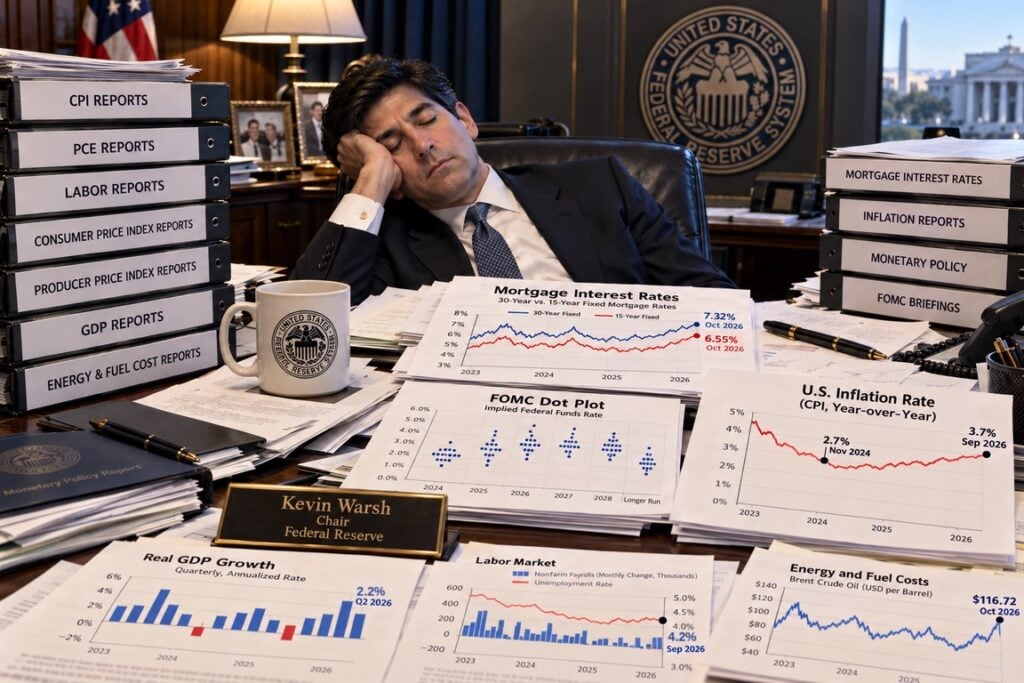
What every Federal Reserve move means for buyers, sellers and homeowners in Washington, DC; updated after each meeting.
The Federal Reserve left its benchmark interest rate, the federal funds rate, unchanged Wednesday in a range of 3.75% to 4.00%.
It was a “Maintain” after September’s quarter-point increase, the Fed’s first hike in three years. Almost everyone saw it coming. The Fed announced the decision at 2:00 p.m. Eastern, at the end of its two-day meeting. CME’s FedWatch tool, which turns trading in interest-rate futures into odds for each possible Fed decision, had put the chance of a hold near 90% going in.
Decision Details
| ITEM | RESULT |
|---|---|
| Decision | Hold |
| Target range | 3.75%–4.00% (unchanged) |
| Vote | 10–2 |
| Dissents | Cook and Hammack, who wanted a quarter-point hike |
| Inflation language | “Inflation remains elevated.” |
| Next meeting | December 8–9, with officials’ new forecasts for rates and the economy |
Source: Federal Reserve FOMC statement, October 28, 2026.
The vote was 10–2, with Governor Lisa Cook and Cleveland Fed President Beth Hammack dissenting. Both wanted a quarter-point hike.
On October 2, the odds of an October hike had just collapsed from 64.2% to 17.2% in a week. A hotter-than-expected September inflation report briefly pushed them back above 34%, but Fed officials’ signals of patience, a soft labor market and an election six days away won out. It was Chair Kevin Warsh’s fourth meeting in charge.
Why the Fed waited
Three things made waiting the easy call. First, hiring has slowed: employers added only 29,000 jobs in September, and revised numbers erased 60,000 jobs from July and August. Second, long-term rates have already made borrowing more expensive on their own. The 10-year Treasury yield, the interest rate on the government’s 10-year bonds and a key benchmark for mortgages, is near 5%. Third, several officials had said there was no rush to move again, including Vice Chair Philip Jefferson and New York Fed President John Williams.
The policy statement:
“The Committee decided to maintain the target range for the federal funds rate at 3-3/4 to 4 percent, in support of the Federal Reserve’s dual mandate. The Committee is continuing its policy of maintaining ample reserves in the banking system.
Economic activity is expanding at a strong pace. While uncertainty remains elevated owing, in part, to geopolitical developments, domestic spending has been resilient. Productivity growth is strong, and capital investment is robust. Job gains have kept pace with the workforce, and the unemployment rate has changed little.
Inflation remains elevated. The accumulation of more information will help the Committee determine the policy stance appropriate to ensure a timely return of inflation to the Committee’s 2 percent goal. The Committee will deliver price stability.
Voting against the monetary policy action were Lisa D. Cook and Beth M. Hammack, who preferred to raise the target range for the federal funds rate by 1/4 percentage point at this meeting.”
This was a “maintain” or “hold”, not a “pause.” A hold is the action taken by the Federal Reserve at a particular meeting, while a pause implies that policymakers are deliberately taking a step back to evaluate incoming inflation and labor data before deciding ongoing strategy.
The case for hiking rates hasn’t gone away and Warsh’s goal to lower inflation to 2% is still the target. September CPI rose 3.7% from a year earlier, gasoline prices remain above $4 a gallon, and inflation has run above the Fed’s 2% target for more than five years. Two committee members, Cook and Hammack, believe the current rate isn’t high enough to cool inflation.
What changed in the Fed’s statement
The statement is short, so small word changes matter. Compared with September’s, three stand out:
- “Maintain,” not “raise.” The Fed held its rate after raising it in September.
- A stronger economy. The Fed now says the economy is growing at a “strong” pace, up from “solid.”
- No promise about the next step. The Fed dropped language tying its moves to getting inflation back to 2%. Instead, it said “the accumulation of more information will help” it decide. In other words, it’s waiting to see the data before committing to anything, including December.
What Warsh said
Chair Kevin Warsh is taking reporters’ questions now. We’ll add the highlights here shortly.
What markets expected going in
Every market gauge pointed to a hold, with traders betting the next hike comes in December. Readings below are from the days before the meeting and the morning of it.
| GAUGE | HOLD AT 3.75%–4.00% | QUARTER-POINT HIKE | DECEMBER HIKE | AS OF |
|---|---|---|---|---|
| CME FedWatch | 90.6% | 9.4% | 86.1% | Oct. 28, 7:15 a.m. |
| CME FedWatch (via Kiplinger) | nearly 90% | — | 73% (42% a month ago) | Oct. 26 |
| CME futures (via tracker) | 90.0% | 10.0% | — | Oct. 26, 6:30 p.m. |
| Kalshi prediction market | 89% | 9% | — | Oct. 26, 6:30 p.m. |
| Polymarket (international) | 93.3% | 6.5% | — | Oct. 26, 6:30 p.m. |
None of them gave a rate cut any real chance. Morningstar noted that odds of an October hold stood at just 36% a month ago.
On the morning of the meeting, FedWatch put the odds of a hike at 9.4%. That was up slightly from 6.6% the day before, but down from 15.5% a week earlier and 70.9% a month ago.
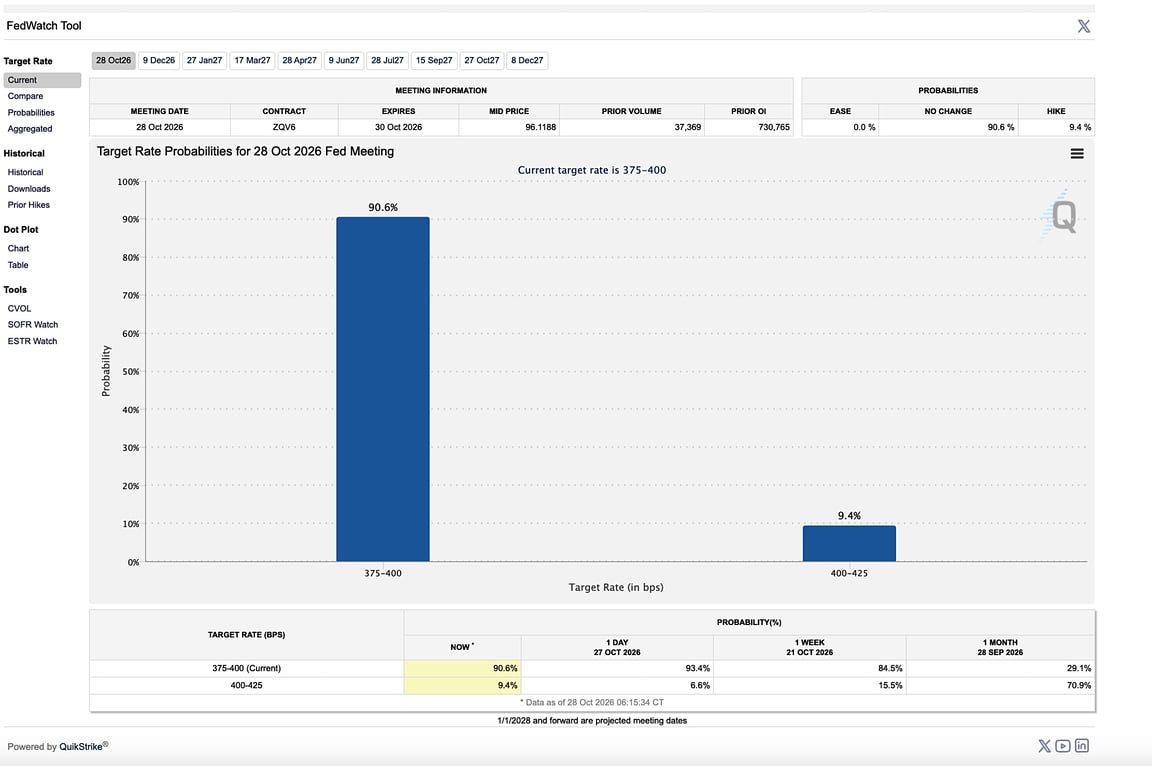
CME FedWatch probabilities for the October 28, 2026 Fed meeting: 90.6% no change, 9.4% hike, as of 7:15 a.m. ET
A month earlier, traders were betting on two hikes by December, with one of them today. Now traders expect that hike in December instead, most likely a single quarter-point increase.
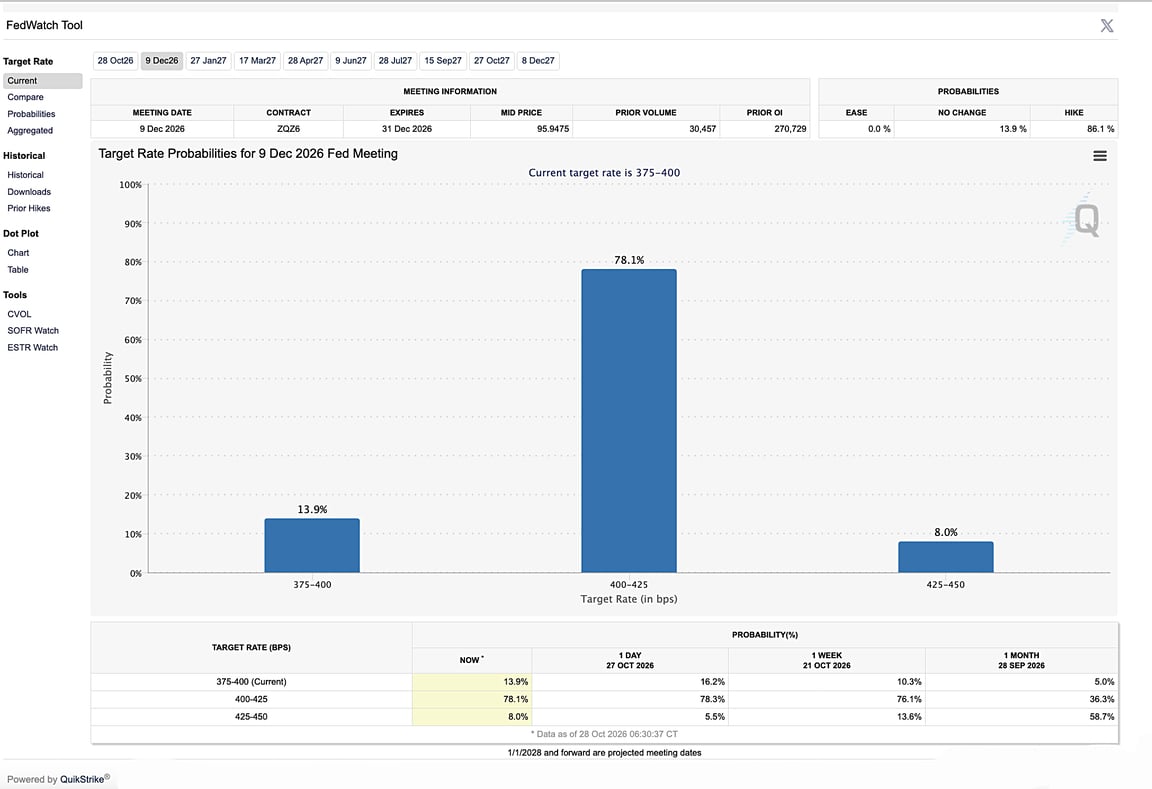
CME FedWatch, December 9 meeting, as of October 28, 2026, 7:30 a.m. ET.
Source: CME FedWatch snapshot, October 28, 2026; earlier FedWatch readings as reported by CBS News and Kiplinger, October 26; Kalshi, Polymarket and CME futures-derived odds from Prediction Market Picks; Morningstar.
How we got here
Cooler inflation, weak jobs (late September to October 2)
The Bureau of Economic Analysis reported September 30 that its August Personal Consumption Expenditures (PCE) price index, the Fed’s preferred inflation gauge, rose 0.3% for the month and 3.4% from a year earlier. “Core” PCE, which leaves out volatile food and energy prices, rose 0.2% and 3.0%. That was lower than economists expected. Two days later, the Bureau of Labor Statistics reported that employers added only 29,000 jobs in September. Unemployment edged up to 4.2%, and revised figures erased 60,000 jobs from July and August.
Fed officials were already signaling patience. New York Fed President John Williams said after the September hike that there was “no need for urgency.” Vice Chair Philip Jefferson said reaching a judgment on the next move “may take more time.” Jefferies’ Thomas Simons called the jobs report “the nail in the coffin for an October hike,” and Goldman Sachs moved its forecast for the next increase to December.
Then CPI ran hot (October 14)
The September Consumer Price Index rose 0.6% for the month and 3.7% from a year earlier, up from 3.4% in August and above the 3.6% economists expected. Gasoline rose 9.1% in the month and accounted for more than half of the increase. Core CPI, which excludes food and energy, rose 0.3% for the month and 2.6% over the year, above the 2.5% forecast and up from 2.4%.
The 10-year Treasury yield climbed past 5.2%, and the probability of an October hike rebounded to 34.9% by 3:00 p.m. that day. Bank of America’s Aditya Bhave argued the September inflation surprise was big and widespread enough to justify a hike this week.
Then patience won out (October 15 to 26)
The odds faded again as the hot inflation report was weighed against the soft labor market and the Fed’s hints that it would take its time. FedWatch put an October hike near 15.5% on October 20 and 9.4% on October 22. On October 17, Fed officials entered their pre-meeting quiet period, when they stop commenting on rates, so no new signals arrived before the meeting. Meanwhile, December hike odds rose to roughly 73%, from 42% a month earlier.
Source: BEA, BLS, CME FedWatch; earlier figures as reported in this post on October 2 and in Inflation Fire Pours Gas On Fed Rate Hike Expectations on October 14. Later FedWatch readings as reported by Kiplinger, CBS News and Alan Longbon.
What comes next: December 8–9
Today’s hold buys the Fed six weeks and one more round of data before its final meeting of the year. Going into today, traders were betting on an 86% chance that rates would be higher after the December meeting, according to FedWatch on the morning of the meeting. Most of that was a single quarter-point hike, with an 8% chance of two.
- Thursday’s reports. Two big reports come out tomorrow: September’s PCE inflation numbers, the Fed’s preferred measure, and the first estimate of growth from July through September. Reuters reported that economists expect both to run hot, with inflation spreading beyond gas prices and growth boosted by consumer spending and AI-driven business investment. If that’s what they show, the case for a December hike gets stronger.
- More data. After that, the October jobs and inflation reports arrive before December. A soft jobs number and cooler prices would strengthen the case for waiting; another hot CPI would make a hike hard to avoid.
- New projections. December brings officials’ updated forecasts, including the “dot plot,” a chart of where each official expects rates to go. In September, the middle forecast put the Fed’s rate at about 4.1% at the end of 2026, which implies one more hike.
- Energy prices. Gasoline drove more than half of September’s CPI increase. Where oil goes will weigh heavily on December.
- The election. With the November 3 midterms over, a December hike won’t look as political.
Fed officials’ quiet period ends Thursday, so expect speeches and interviews to fill in what the statement and press conference left open.
What the bond market is saying
The Fed’s decision moves short-term and variable-rate borrowing most directly: credit cards, home equity lines of credit (HELOCs), adjustable-rate mortgages when they reset, and the rates banks pay on savings. Fixed-rate mortgages don’t work that way. They follow the bond market, especially the 10-year Treasury yield and the prices investors pay for bundles of mortgages. So let’s look at what the bond market is doing and how it could influence mortgage rates in the coming weeks.
The bond market had already moved before the Fed did. The 10-year Treasury yield rose to its highest level since 2007 in mid-September, as traders bet on the Fed’s first hike in three years. It climbed past 5.2% after the hot CPI report on October 14, stood at 5.15% on October 19, and eased to about 4.99% by October 26.
That drop suggests investors had bet on more rate hikes than the Fed was ready to deliver this month. But they haven’t given up on them. Futures markets still put the odds of a December hike at about 86%, so the market sees today’s hold as a breather, not the end of rate hikes.
Higher long-term rates have also been doing some of the Fed’s work by making borrowing more expensive on their own. Economists at Deutsche Bank and strategists at Glenmede both made that point before the meeting. Oil is pushing the other way. Brent crude, the global oil benchmark, settled at $116.72 a barrel on October 23 on worries about Middle East supply. High oil prices keep inflation fears, and long-term rates, high.
The gap between mortgage rates and Treasuries
Thirty-year mortgage rates usually sit above the 10-year Treasury yield. That gap was about 1.97 percentage points in early September, according to Wolf Street. With Freddie Mac’s rate at 7.32% and the 10-year near 5.0%, it has widened to about 2.3 points. That’s wider than the gaps of less than 1.5 points from 2008 to 2022, when the Fed was buying mortgage bonds, but well below the 3-plus points of 2023.
What today’s hold means for DC mortgage rates: We’ll update this after Chair Warsh’s press conference, once bond markets have had time to react.
Source: Bloomberg and CNN on September highs; WRE News for October 19–23 yields and Brent crude; Wolf Street on the spread; Kiplinger for Deutsche Bank and Glenmede; Mortgage News Daily for October 26 yields. Spread calculated from Freddie Mac’s October 22 rate and the 10-year yield.
What this could mean for mortgage rates
Mortgage rates eased slightly heading into the meeting but remain more than a full point above last year. The Fed sets a short-term rate that banks charge each other overnight. It doesn’t set the 30-year mortgage rate, which follows what investors pay for bundles of mortgages and tends to move with the 10-year Treasury yield. With the 10-year near 5%, the bond market has already pushed borrowing costs up.
| MEASURE | LATEST | PRIOR READING | YEAR AGO |
|---|---|---|---|
| Mortgage News Daily 30-year fixed (daily) | 7.33% (Oct. 26) | 7.40% (Oct. 20) | 6.19% |
| Freddie Mac 30-year fixed (weekly) | 7.32% (Oct. 22) | 7.40% (Oct. 15) | 6.27% |
| 10-year Treasury yield | 4.99% (Oct. 26) | above 5.2% (Oct. 14) | — |
| 2-year Treasury yield | 4.70% (Oct. 26) | — | — |
Source: Mortgage News Daily and Freddie Mac’s weekly survey via Mortgage News Daily; Treasury yields from MND and Kiplinger, October 26, 2026.
Are DC mortgage rates different?
It’s one of the most common questions buyers ask, and it rarely gets reported. The short answer: DC buyers pay about what the rest of the country pays, maybe a hair more on a standard 30-year loan.
| SOURCE | DC 30-YEAR FIXED | NATIONAL 30-YEAR FIXED | DIFFERENCE |
|---|---|---|---|
| Bankrate (Oct. 27) | 7.46% | 7.38% | +0.08 point |
| Zillow (Oct. 26) | 7.49% | 7.35% | +0.14 point |
The gap is small because mortgage rates are set mostly in national bond markets. Local differences come from things like loan limits, loan size and property type, and every quote also depends on the borrower. For the full explanation, see Why Isn’t There Just One Mortgage Rate?
One difference may matter more in DC than elsewhere. Zillow’s DC quote for a 30-year jumbo loan, for amounts above the cap on standard (“conforming”) loans, was 6.75%, below its standard 30-year rate. With so many DC purchases above that limit, some buyers here may find jumbo pricing more favorable than they’d expect.
Two things to keep in mind. These are averages of lender quotes, not a formal survey like Freddie Mac’s. And a gap of a tenth of a point is the kind of change you’d see from one day to the next. Zillow’s DC figure is its own lending arm’s quote, while its national figure is a marketplace average, so that row isn’t a perfect apples-to-apples match. Freddie Mac doesn’t publish DC rates, so long-term charts have to use national numbers.
Source: Bankrate, October 27, 2026; Zillow Home Loans, Washington, DC, October 26, 2026; Zillow national average via U.S. News, October 26, 2026. Individual quotes depend on credit score, down payment and loan size.
On a $500,000 loan repaid over 30 years, principal and interest is about $3,438 a month at 7.33%, compared with $3,059 at last year’s 6.19%. That’s roughly $379 more each month for the same loan, before taxes, insurance or HOA fees.
Everyone saw today’s hold coming, and lenders had already built it into their rates, so on its own it shouldn’t move mortgage rates much. What matters more is how Warsh sounds. A press conference that points firmly to December could push Treasury yields and mortgage rates back up, while signs of patience could keep rates drifting lower. The October jobs and inflation reports due before December will matter as much as anything said today.
Payment examples calculated using a $500,000 loan repaid in 360 monthly payments; figures rounded to the nearest dollar.
Sources
- Federal Reserve: FOMC meeting calendar and statements | Origin source. Meeting dates, the 2:00 p.m. release, and the October 28 statement and vote.
- CME FedWatch Tool | Origin source. Probabilities derived from 30-Day Fed Funds futures. Snapshots taken for this post (October 2, October 14 and October 28) are the primary readings; other readings are as reported by the outlets below.
- CBS News: “Federal Reserve to announce its latest interest rate move this week,” October 26, 2026 | FedWatch odds of 88% for a hold and 71% for a December hike; Warsh press conference and forward-guidance context; gasoline above $4 for three months.
- Kiplinger: October 2026 Fed Meeting live updates, October 26, 2026 | FedWatch near 90% hold and 73% December hike (42% a month earlier); no new forecasts at this meeting; blackout dates; 2026 voters; Deutsche Bank and Bank of America commentary; September CPI details; 2-year Treasury yield.
- AP via U.S. News: “5 things to watch from the Federal Reserve’s next meeting,” October 27, 2026 | Fourth meeting under Warsh; Hammack and Logan as likely hawkish dissenters; 30-year mortgage at 7.4% earlier in October.
- Morningstar: “What to Expect from the October 2026 Fed Meeting” | Pause odds up from 36% a month earlier to 90%.
- Alan Longbon: “The US Fed’s October Meeting: A Pause With A Hike In Reserve,” October 26, 2026 | Independent analysis. FedWatch path from late September through October 22; July dissents; CME Group study of pre-election holds. Secondary source for those FedWatch readings.
- TradingKey: October 2026 FOMC preview | FedWatch 90.6% hold and 9.4% hike as of October 22; September dot-plot median of 4.1% for end of 2026.
- Prediction Market Picks: Fed rate tracker, October 2026 | Kalshi, Polymarket and CME futures-derived odds as of October 26, 6:30 p.m. ET.
- Mortgage News Daily: 30-year fixed rates | MND daily and Freddie Mac weekly 30-year rates with year-ago comparisons; 10-year Treasury yield.
- Bureau of Labor Statistics: September 2026 Employment Situation | Origin source. September payrolls, unemployment and revisions.
- Bureau of Labor Statistics: Consumer Price Index | Origin source. September CPI, released October 14.
- Bureau of Economic Analysis: August 2026 Personal Income and Outlays | Origin source. August PCE figures.
- Federal Reserve: Vice Chair Jefferson, “The U.S. Economy and Monetary Policy,” October 1, 2026 | Origin source for the Jefferson quote.
- Reuters: “Fed’s Williams sees no urgency for next rate hike,” September 29, 2026 | Williams quote.
- Financial Times: September jobs report, October 2, 2026 | Simons quote.
- Reuters: Goldman Sachs pushes Fed hike forecast to December, October 1, 2026 | Goldman forecast change.
- Reuters: Fed preview, October 26, 2026 | Economists’ expectations for Thursday’s September PCE and third-quarter GDP reports.
Disclaimer
The information provided on this site is for general informational and educational purposes only and does not constitute professional real estate, legal, or financial advice. While we strive to keep information accurate and up-to-date, topic details, property details, market conditions, prices, and availability are deemed reliable but not guaranteed. Readers should conduct their own independent due diligence and consult with a licensed real estate broker, attorney, CPA, financial advisor or appropriate District of Columbia government agency to verify information and policy. Content subject to change without notice. realestateinthedistrict.com and dcrealestate.channel, their owners, operators and writers disclaim any liability for any loss or damage-arising directly or indirectly from the use of or reliance on any information provided on this blog. This blog and its affiliated social media channels are the sole property and responsibility of their owner, and are not affiliated with Compass International Holdings (CIH).