
Published mortgage rates are confusing. Borrower profiles, best case scenarios and backward-looking data obscure the actual rate an individual buyer will receive.
Oct 27, 2026 · Susan Isaacs
There’s no single mortgage rate because a rate is a price, and lenders set that price for each loan, place and borrower. The headline number you see on the news is an average, not an offer.
Many borrowers are caught off guard by this. A friend in Maryland mentions a rate, a news site quotes another, and the lender you call in DC offers a third. None of them is necessarily wrong. They’re just describing different loans.
Start with the national baseline
Every mortgage rate in the country starts from the same place: the cost of money in the bond market. Lenders watch the yield on the 10-year Treasury and the prices investors pay for mortgage-backed securities. When those move, rates move nationwide, often within a day.
The Federal Reserve doesn’t set mortgage rates directly. Its decisions shape inflation expectations and short-term borrowing costs, which feed into what investors demand. That’s the tide that lifts or lowers every boat.
What happens next is local. Each lender adds its own margin and adjusts for the specific loan in front of it. That’s where location starts to matter.
Six reasons rates vary from place to place
1. Lender competition
Lenders differ in overhead, capacity and appetite for risk, so the same borrower can get different quotes from different lenders. Local competition matters less for the rate than many people assume, though. Research finds that rates on Fannie Mae and Freddie Mac loans barely vary from region to region for otherwise identical borrowers, and that local lender concentration shows up mainly in fees and approval rates instead.
2. Loan size
Home prices shape loan amounts, and loan amounts shape pricing. Loans that are particularly small or particularly large can carry higher rates. In high-cost areas, bigger loans can also push borrowers into a different loan category altogether.
3. Loan limits
Conforming loans, the ones Fannie Mae and Freddie Mac buy, have a cap. That cap is higher in expensive counties. A loan above the local limit is a jumbo loan, priced by each lender’s own appetite for risk. So the same loan amount can be conforming in one county and jumbo in the next, with a different rate attached.
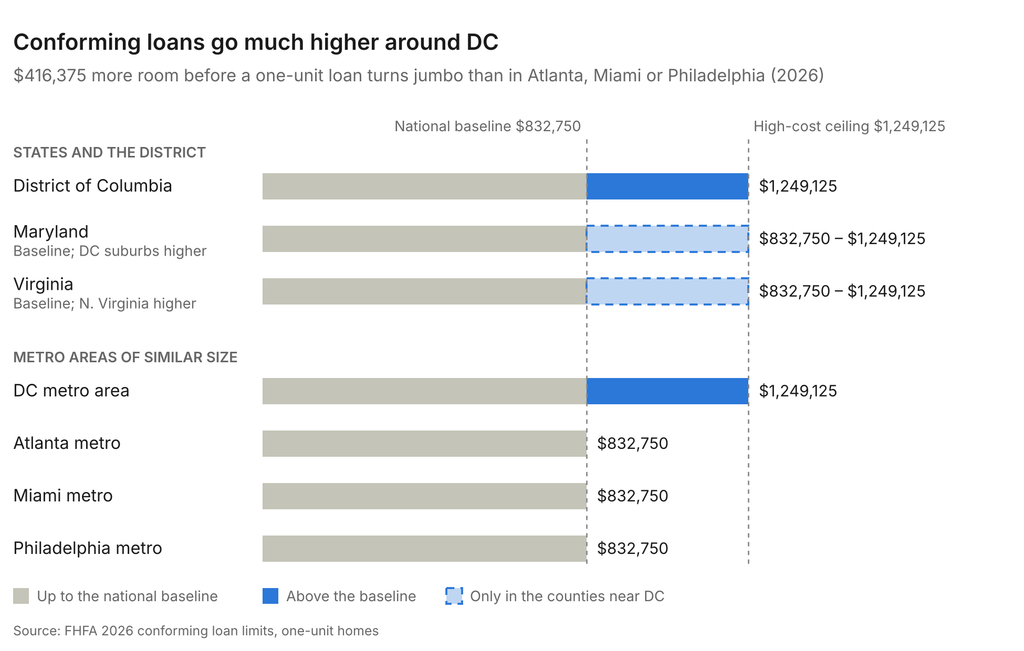
The whole DC metro sits at the national high-cost ceiling, while the Atlanta, Miami and Philadelphia metros all use the baseline. In Maryland and Virginia, only the counties near DC get the higher cap; the rest of each state uses the baseline. FHFA announces 2027 limits each November (FHFA 2026 announcement, county list).
4. State and local rules
Foreclosure law differs by state, and foreclosures that go through the courts take much longer. Fannie Mae and Freddie Mac don’t charge more in those states: regulators proposed state-level fees in 2012 and later dropped the idea. Private lenders, including jumbo lenders, do price in some local risk. Local taxes, recording fees and title costs also change the total cost of a loan, even when the rate itself looks similar.
5. Property type
Condos, second homes, investment properties and manufactured homes carry extra pricing adjustments on Fannie Mae loans. The condo adjustment depends mainly on your down payment, not the building. Building problems matter in a different way: pending litigation, thin reserves or one investor owning too many units can make a project ineligible for Fannie Mae or Freddie Mac financing. Buyers then need a portfolio or specialty loan, which usually costs more.
6. Who’s borrowing
Local markets attract different mixes of buyers: first-timers, investors, second-home buyers, military families using VA loans. Credit scores, down payments and loan programs vary with that mix. Average quoted rates in an area reflect the borrowers there, not just the lenders.
What this means if you’re buying in DC
Several of these factors show up strongly in the District. DC is a high-cost area, so a loan of up to $1,249,125 can still be conforming in 2026. Loans above the $832,750 national baseline are “high-balance” loans, which can carry an extra Fannie Mae pricing adjustment. Knowing where your loan amount falls can change your rate.
The city also has a large share of condos and co-ops: about 64,300 condo units and 28,600 co-op units out of roughly 304,000 homes, according to a 2019 DC Policy Center count. Those bring their own pricing adjustments and building approval requirements. Buyers can also shop lenders across DC, Maryland and Virginia, and quotes for the same loan can differ.
Loan limits reset every January, and FHFA announces the next year’s limits in late November. Confirm the current limit and any condo adjustments with a lender before you rely on a number.
What affects my mortgage rate?
Your rate depends on your credit score, down payment size, loan term (such as 15 vs. 30 years), loan type (conventional, FHA or VA) and broader economic conditions. The CFPB’s guide lists seven core factors: credit score, home location, home price and loan amount, down payment, loan term, fixed vs. adjustable rate, and loan type (CFPB, PNC).
Can you negotiate your rate?
Yes, but less than most people expect. A personal rate is priced from your details, not set freely by the person quoting it.
Most lenders price loans from a daily rate sheet. It starts from what investors, including Fannie Mae and Freddie Mac, will pay for the loan. It then adds or subtracts set amounts for your credit score, down payment, loan size, property type and lock period. Federal rules also bar loan officers from earning more for steering you into a higher rate, which removes some of the old room to haggle.
Where you can push:
- The lender’s margin. Each lender adds its own markup. A competing Loan Estimate is your best tool, and lenders may negotiate when you bring a written offer from a competitor.
- Points and credits. Pay points upfront for a lower rate, or take a slightly higher rate in exchange for credits toward closing costs.
- Fees. Origination, application, processing and underwriting fees often have more give than the rate.
- Your own inputs. A higher credit score, a bigger down payment or a different lock period moves you to a better price.
You can’t argue with the rate sheet, but you can shop the markup and the fees.
Three unfair things about the way mortgage rates are quoted
Mortgage pricing often feels unfair because lender discretion, market spreads and risk add-ons all stack on top of each other, and borrowers rarely see how.
- Rate markups for extra pay. Brokers once earned a “yield-spread premium” by pushing a borrower’s rate above the lender’s wholesale par rate. Since 2011, federal rules bar paying brokers or loan officers more for a higher rate, and regulators have fined lenders that found workarounds. A lender can still build its own margin into the rate, though, so the same borrower can get very different quotes. The Center for Responsible Lending still advises asking how your broker is paid.
- Surcharges for non-traditional properties. Pricing adjustments and higher rates for condos, manufactured homes, second homes and investment properties fall hardest on buyers who can’t afford a traditional single-family home as a primary residence. NerdWallet explains how lenders price these loans as riskier.
- Teaser rates with hidden costs. Advertised rates are often the best case. They can assume a top credit score, a large down payment or discount points paid upfront. Compare the APR and the Loan Estimate, not the headline rate, to see what a rate really costs.
Every quote is personal
Location explains part of the gap, but the rate you’re offered is built around you: your credit score, down payment, loan type, the property and the day you lock. That’s why the best way to know your rate is to ask for one.
A few habits help:
- Get Loan Estimates from at least three lenders on the same day, for the same loan. Credit checks within 45 days count as a single inquiry.
- Compare the Loan Estimate, not just the rate. Points and fees change the real cost.
- Ask whether your loan is conforming or jumbo, and whether any property adjustments apply.
- Check the APR alongside the rate to see the fuller picture.
The national average is a useful weather report. Your quote is the forecast for your own street.
Sources
How rates are set nationally
- What Determines Mortgage Rates?, Federal Reserve Bank of St. Louis, Oct. 2026: 10-year Treasury, MBS spread and the Fed’s indirect role
- How Are Mortgage Rates Determined?, NerdWallet, updated Mar. 2026: daily rate moves, lender differences, property-type pricing
Why rates vary by place
- Regional Redistribution through the US Mortgage Market, Hurst, Keys, Seru and Vavra, American Economic Review, 2016: GSE rates don’t vary by region; private-market rates do
- Do Mortgage Lenders Compete Locally?, Washington Center for Equitable Growth: local concentration affects fees and approvals more than rates
- Seven factors that determine your mortgage interest rate, CFPB (archived, 2017): location, loan size, down payment, term, rate type, loan type, points
- State-Level Guarantee Fee Pricing notice, FHFA, Federal Register, Sept. 2012, and FHFA cancels g-fee hikes and differential pricing, National Housing Conference
- Loan-Level Price Adjustment Matrix, Fannie Mae, Sept. 2026: condo, second-home, investment, manufactured-home and high-balance adjustments
- Ineligible condo projects (B4-2.1-03), summary of Fannie Mae’s Selling Guide via Enact MI
Loan limits
- FHFA Announces Conforming Loan Limit Values for 2026, FHFA, Nov. 25, 2025, and the full county list
- County limits used in the chart: DC (SoFi), Maryland (NFM Lending), Virginia (Lower), Georgia and Florida (JVM Lending), Pennsylvania (Lower), New Jersey (Rocket Mortgage)
DC housing
- Single-family homes take up a lot of space in the District, D.C. Policy Center, 2019: condo and co-op unit counts
Negotiating and shopping
- CFPB Takes Action Against Guarantee Mortgage, CFPB: loan originator compensation rule, enforced since July 2011
- 8 Signs of Predatory Mortgage Lending, Center for Responsible Lending: yield-spread premiums
- Mortgage moves: How many loan offers will you get?, CFPB: at least three Loan Estimates; 45-day credit window
- What affects mortgage rates, PNC