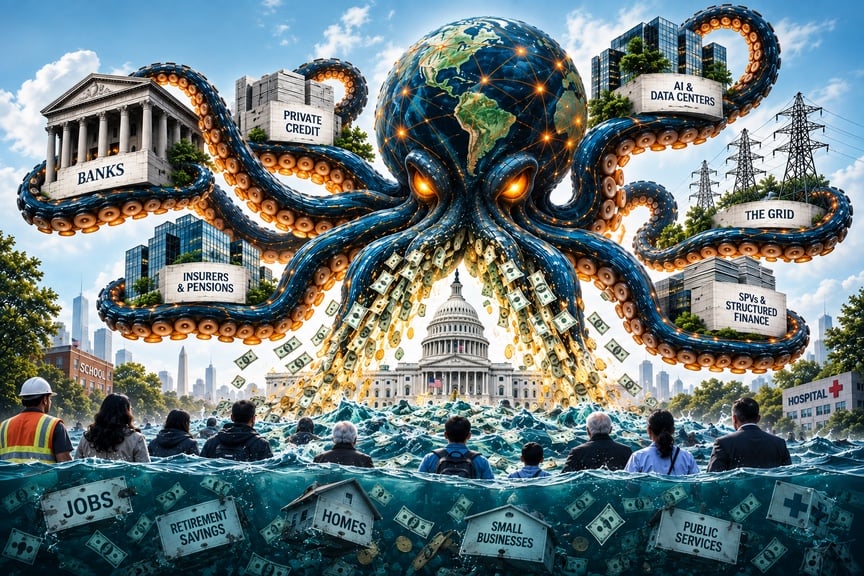
The Tentacles of an Interconnected Financial System Are Spreading Risk
When the financial system nearly collapsed in 2008, Washington’s problem appeared to have names and addresses. Lehman Brothers failed. AIG nearly did. Citigroup and Bank of America required extraordinary support. The country’s largest financial institutions had become so enormous and interconnected that allowing one to collapse could threaten the rest of the system.
When the financial system nearly collapsed in 2008, Washington’s problem appeared to have names and addresses. Lehman Brothers failed. AIG nearly did. Citigroup and Bank of America required extraordinary support. The country’s largest financial institutions had become so enormous and interconnected that allowing one to collapse could threaten the rest of the system.
When the financial system nearly collapsed in 2008, Washington’s problem appeared to have names and addresses. Lehman Brothers failed. AIG nearly did. Citigroup and Bank of America required extraordinary support. The country’s largest financial institutions had become so enormous and so connected to one another that allowing one to collapse could threaten the rest of the system.
“Too Big to Fail” became a public buzzword; a sneer aimed at giant institutions. Washington’s response to the crisis also focused largely on them. New regulations required banks to keep larger financial cushions to absorb losses, maintain more readily available cash and other liquid assets, undergo regular financial stress tests and prepare detailed plans for how they could fail without taking the economy with them.
The new buzzword: Dodd-Frank. Those reforms changed the banking system. They didn’t freeze the financial world in place.
More lending and investing now takes place outside traditional banks, through private-credit funds, insurers, pension funds, asset managers and other financial vehicles. Banks haven’t disappeared from this new ecosystem. Quite the opposite. They’re connected to it through loans, credit lines, guarantees, derivatives and other financing arrangements. A complex network has become more complex. The result begins to look less like a collection of separate financial institutions and more like an expanding network with tentacles reaching into different parts of the economy. The institutions may have different names, different regulators and different rules. But their money and risks can still lead back to one another.
What if “Too Big to Fail” is no longer adequately described by the size of an institution because systemic importance can also develop through a network? Should the term now be: “Too Interconnected To Fail?”
Two 2008 Problems
“Too Big to Fail” and the socialization of private losses are related problems, but they aren’t the same problem:
Too Big to Fail describes what happens when allowing a financial institution to collapse could do so much damage elsewhere that the government faces enormous pressure to intervene. Its failure could freeze lending, spread losses to other institutions or disrupt something the economy needs to keep functioning.
“Socialized losses” is what happens when losses taken by private companies or investors somehow end up being absorbed by the public.
After 2008, Dodd-Frank attempted to address both. Banks were required to keep larger financial cushions against losses and more resources available to survive periods of financial stress. Regulators began regularly testing how the biggest banks might perform during a severe downturn.
Large financial companies also had to engage in estate planning. These “living wills” are supposed to answer a fairly straightforward question: If this company fails, how do we take it apart without blowing up everything connected to it?
Thanks to Dodd-Frank, that system is substantially stronger than what existed before 2008. In May 2026, the Federal Reserve and FDIC reported that the latest living wills from the eight largest and most complex domestic banking organizations passed their review without identified shortcomings or deficiencies. That doesn’t prove every enormous bank could be dismantled cleanly during every imaginable crisis. It just shows how much regulatory attention has been devoted to making individual giant banks safer to fail.
But what if the next “Too Big to Fail” problem isn’t contained inside one institution?
The Network Beyond the Banks
Private credit is a good place to start because it’s grown enormously and most people outside finance don’t know a lot about it aside from the name. “Private credit” sounds pretty self-explanatory, but once we get into who is actually doing the lending and where their money comes from, things get murky. Private credit is lending done primarily through investment funds and other nonbank lenders rather than traditional banks. A company needs money. Instead of borrowing from a bank or selling bonds to investors, it borrows from one of these funds. And many companies do it. The Federal Reserve estimates that U.S. private-credit loans reached about $1.4 trillion by the second half of 2025. That’s approximately 10% of all debt owed by U.S. nonfinancial corporations and roughly one-third of the corporate debt considered below investment grade, once bank loans are excluded.
Banks do it, too. They’ve promised $2.6 trillion in loans and other financing to financial companies that aren’t banks. Private equity, business development companies and private-credit vehicles made up the largest piece of that total, and bank commitments to that group grew 17% during 2025.
So risk that appears to have moved outside the banking system hasn’t necessarily left the banks behind.
The Financial Stability Board (FSB), the international organization that monitors risks to the global financial system, estimates that the worldwide private-credit market has grown to between $1.5 trillion and $2 trillion. It has been watching several potential weak spots, including heavy borrowing, risky borrowers, investments that can be difficult to value or sell quickly, concentrations of money in similar places and the growing connections among private-credit funds, banks, insurers and private-equity firms.
The FSB isn’t saying private credit is a disaster waiting to happen. The concern is that this enormous market hasn’t yet been tested through a severe economic downturn at its current size. And some very familiar money is sitting inside it.
European Central Bank researchers found that insurers and pension funds accounted for 70% of investments in global private-credit funds between January 2017 and May 2026. U.S. insurance regulators have also begun demanding more detailed information about insurers’ investments because some of these assets can be difficult to value and aren’t traded frequently. So this doesn’t just involve wealthy investors and obscure Wall Street funds. Retirement and insurance money is part of it too. Picture the connections. A private-credit fund lends money to a company. Pension funds and insurers may have invested in that fund. A bank may lend money to the private-credit fund while also providing a credit line to the company that borrowed from it. Every participant may look at its own piece and decide the risk is manageable. But if several of them are ultimately depending on the same company, industry or financial bet succeeding, their risks aren’t really independent.
Follow one tentacle far enough and it can lead back to another.
The Visibility Problem
Phil Angelides chaired the Financial Crisis Inquiry Commission that investigated the 2008 market crash. In a 2012 FRONTLINE interview, he said that regulators and policymakers hadn’t adequately understood how the financial system they were supposed to oversee actually worked. The problem wasn’t simply that people made bad mortgages. Risk had been packaged, sold, borrowed against and connected through increasingly complicated financial products. Trouble could move from one part of the system to another in ways regulators didn’t understand and hadn’t comprehended before the crisis hit.
Today’s financial system isn’t the same one Angelides investigated, but the problem of regulators and their overseers in Congress understanding the system hasn’t disappeared.
The FSB says regulators still don’t have enough information to see all the risks in private credit or all the ways trouble in one part of the system could spread to another. U.S. insurance regulators are asking for more detailed information about insurers’ private-credit investments. Meanwhile, Federal Reserve data show rapidly growing bank financing of nonbank financial companies.
A risk that looks manageable within a single company may look unmanageable within a network of interconnected companies. And those connections can be hard for regulators to trace.
At the very same time, Washington is changing some of the post-2008 rules intended to contain or reveal that risk.
The Regulatory Safeguards Are Being Recalibrated
The current deregulatory program didn’t materialize after the administration took office. Project 2025 was built as a governing agenda for a future conservative administration, and its financial-regulation proposals were extensive. Among them was a recommendation to repeal major sections of Dodd-Frank, including the provisions that created the Financial Stability Oversight Council, or FSOC, and the government’s special process for dealing with the failure of a large financial company whose collapse could threaten the system.
That doesn’t mean Project 2025 caused every regulatory decision that followed. It also doesn’t mean regulators changed a rule simply because the financial industry wanted it changed. Regulators have offered their own reasons, including reducing unnecessary costs, encouraging economic growth, focusing supervision on the most serious financial risks and improving the operation of important financial markets.
Some of those arguments are legitimate and deserve to be considered. But several safeguards created after the financial crisis are now being changed at the same time. The network is extending more tentacles while some of the barriers designed to contain financial trouble are being lowered or repositioned.
Less Capital Between Losses and the Public
In November 2025, the Federal Reserve, FDIC and OCC changed the enhanced supplementary leverage ratio, or eSLR.
It’s one of the regulatory rules that requires certain banks to keep a certain amount of their own financial cushion available to absorb losses based on the total amount of assets they hold. The rule has a quirk. It generally counts assets the same way whether they’re relatively safe U.S. Treasury securities or something considerably riskier. Regulators and banks have argued that this can discourage banks from buying and selling Treasuries because holding more of them can increase the amount of capital the bank is required to maintain. The agencies said their change would make the rule more of an emergency safety net and less likely to interfere with banks’ everyday role in the enormous Treasury market.
Before the change, the country’s eight largest and most systemically important banks had to maintain an extra financial cushion against losses, and their banking subsidiaries faced an even larger one. The new rule reduced those requirements and changed how they’re calculated. For the banking subsidiaries, the maximum requirement fell from 6% of their assets to 4%.
There’s a legitimate argument that treating every asset alike makes little sense when some assets are far safer than others. But the simplicity is also part of the rule’s purpose. Whatever a bank or its regulators think an asset’s risk might be, the bank still has to maintain a basic financial cushion against everything it owns.
Under the new rule, the agencies estimated that the amount of top-quality capital the affected bank holding companies would be required to maintain would fall by less than 2%. They also said they didn’t expect the banks’ actual capital levels to change much. So why change the rule? The agencies argue that lowering the requirement gives banks more room to buy and sell low-risk assets such as Treasury securities without bumping up against the leverage rule.
The financial industry had actively sought the change. Representatives of three major financial trade groups met with Federal Reserve staff in September 2025 and presented a document called “Support for eSLR Recalibration.” The final rule substantially adopted the main change they supported, although regulators didn’t give the industry everything it requested.
Not everyone at the Federal Reserve agreed with the regulators’ assessment of the risk, though. Fed Governor Michael Barr, who dissented from the rule, calculated that the change would reduce one important capital requirement at the banking subsidiaries of the country’s largest banks by $219 billion, or 28%. The effect at their parent companies would be much smaller because other capital requirements would still apply. Barr also pointed out that banks aren’t required to use the additional capacity for Treasury-market activity. They could instead use it for more profitable investments or return capital to shareholders.
And this wasn’t the only capital rule being reconsidered.
In March 2026, regulators proposed broader changes to the capital requirements for large banks. Barr estimated that those proposals, together with changes to the Federal Reserve’s stress tests, would reduce one of the main capital requirements for the largest banks by approximately 4.8%. Add the earlier leverage-rule change, he calculated, and the reduction in a key measure of required capital for the eight U.S. banks considered globally systemically important would be about 6%, or approximately $60 billion.
Those are Barr’s estimates, not the regulators’ description of the changes.
But his numbers point to a larger question: what happens when several safeguards are reduced at the same time? Each change may have a reasonable argument behind it. Together, they determine how much of a financial cushion remains available to absorb losses before trouble can spread beyond the institutions that took them.
Less Aggressive Supervision
The changes aren’t limited to how much capital banks have to maintain. The Federal Reserve has also changed how it supervises large financial institutions. It says regulators should concentrate more heavily on serious financial risks and spend less time on problems involving procedures, paperwork and documentation.
And there’s a disagreement over where the line gets drawn.
In November 2025, the Fed changed its rating system so that a large financial institution can have one area regulators consider seriously deficient and still be classified overall as “well managed.” Fed Vice Chair for Supervision Michelle Bowman argued that the old system could label a financially strong institution as not well managed because of one problem and that the new approach gives a more accurate picture of the company as a whole.
Barr disagreed. The rating isn’t supposed to describe a minor paperwork problem, it means regulators have found deficiencies serious enough to put the firm’s ability to remain safe and sound through a range of conditions at significant risk. Barr argued that allowing a company with that rating to remain classified as well managed reduces the pressure to fix the problem and could allow it to expand or make acquisitions before the deficiency is corrected.
The Independent Community Bankers of America opposed the change too, warning that it could make it easier for already enormous banks to become even larger.
This doesn’t mean bank supervision has disappeared. It means regulators are changing the point at which a serious problem produces consequences for the bank; and potentially the network.
A Narrower Path to Systemic Nonbank Oversight
Now we come back to all that financial activity moving outside traditional banks.
Dodd-Frank created the Financial Stability Oversight Council, or FSOC, partly to look across the financial system for dangers that might not fit neatly inside one regulator’s territory.
FSOC also has an important power. If a financial company that isn’t a bank becomes so important that its failure could threaten the U.S. financial system, FSOC can bring that company under tougher Federal Reserve supervision.
The fight is over how readily that power should be used.
In July 2025, nineteen financial and business trade associations wrote directly to Treasury Secretary Scott Bessent, who also chairs FSOC. The coalition represented asset managers, investment advisers, insurers, mortgage companies, real estate, private funds and other financial interests.
They wanted FSOC to return to an earlier approach. Instead of first asking whether one particular nonbank company had become dangerous enough to require tougher supervision, they wanted regulators to focus first on risky activities occurring across the financial system. Putting an individual company under enhanced Federal Reserve supervision would become more of a last resort.
In March 2026, Bessent’s FSOC unanimously proposed moving back in that direction. Bessent said the council should first focus on risky activities and practices across financial markets rather than singling out individual companies. The timeline doesn’t prove that the industry’s July letter caused FSOC’s March proposal. Bessent and FSOC have their own stated policy reasons for changing the approach. But we do know that affected industries directly asked for a specific change and that the proposal that followed moved substantially in the same direction.
And that brings us into a strange circle.
After 2008, tougher bank regulations made it more expensive to conduct some kinds of financial business inside banks. Some of that business moved outside them. Banks then became increasingly connected to the nonbanks doing it.
Policymakers now point to the movement of financial activity outside banks as one reason to reconsider some bank regulations. At the same time, FSOC is proposing to put greater emphasis on regulating risky activities across the market before using its main tool for placing an individually dangerous nonbank company under tougher Federal Reserve supervision.
Which raises a pretty basic question. Where, exactly, is the systemic risk supposed to be regulated?
Less Information While Visibility Is Already Incomplete
Then there’s Form PF.
The name is almost comically unhelpful, but the idea isn’t complicated. It’s a confidential report that gives federal regulators a look inside private investment funds for signs of risk that could spread through the financial system. And surprising no one, the private-fund industry has been pushing to reduce those reporting requirements.
The Managed Funds Association asked SEC Chairman Paul Atkins in 2025 to undo recent expansions of Form PF and rethink the form. In December, the group argued that requiring private-fund advisers with at least $150 million under management to file captured firms that were simply too small to pose a serious threat to the financial system.
The industry’s recommendations and the government’s eventual proposal aren’t identical, and that distinction is important. The Managed Funds Association didn’t propose raising that general $150 million cutoff to $1 billion. Its $1 billion recommendation applied to a different category of hedge fund. Other industry organizations supported the $1 billion general cutoff later, after regulators proposed it.
In April 2026, the SEC and CFTC proposed raising the general reporting threshold themselves from $150 million to $1 billion.
Here’s what that would mean.
About 43% of the private-fund advisers currently required to file Form PF would no longer have to do it. Regulators say they’d still receive information covering approximately 94% of all the money invested in private funds because the advisers dropping out of the reporting system are relatively small. The proposal would also require better identification of private-credit funds, so this isn’t simply a case of regulators turning off the lights. They would gain some useful information while giving up other information.
If the goal is simply to keep track of where almost all the money is, that may sound like a reasonable trade. But Form PF can also help regulators see how that money is connected. A smaller fund may represent a tiny fraction of the industry’s total assets while still borrowing from a bank, investing alongside other funds or holding the same assets they do. Remove its report and regulators don’t just lose sight of its dollars. They lose sight of some of those connections.
That’s the problem with measuring visibility only by assets. Regulators could still see 94% of the money while losing information about a much larger share of the firms participating in the network.
The $150 million-to-$1 billion Form PF threshold change is still a proposal, not a final rule. On August 31st, the SEC and CFTC postponed the compliance date for the separate 2024 Form PF amendments until July 1, 2027. The CFTC specifically said the extension gives the agencies time to “fully consider comments received on the April 2026 rule proposal.” SEC Chairman Paul Atkins likewise said staff were still reviewing comments and working to conclude consideration of final amendments.
Want to follow the rulemaking and comments? The formal public-comment period closed June 23, 2026, but the SEC maintains a public docket containing the comments submitted on the proposal as well as records of subsequent meetings with SEC officials. The proposal is File No. S7-2026-13.
Will Deregulation Produce the Lending Washington Promises?
There is another side to this debate, and it’s important.
Treasury isn’t arguing that financial regulation should simply disappear. Its case is that some rules created after 2008 have become so restrictive that they push lending and other financial activity outside banks and prevent banks from putting money to productive use.
In March, prepared remarks by Treasury Secretary Scott Bessent described a “fundamental reset” of financial regulation. The remarks, delivered by Under Secretary for Domestic Finance Jonathan McKernan, argued that regulation had helped push financial activity away from banks and toward less regulated nonbanks.
Treasury says some of the rules designed to make sure banks can survive a financial emergency now unnecessarily limit their ability to lend. Its stated goal is striking: unlock “hundreds of billions, potentially trillions” of dollars in additional lending capacity for AI infrastructure, domestic supply chains and the defense industrial base.
So does reducing these requirements actually produce all that additional lending? There is evidence that tougher capital requirements can reduce lending by the banks subject to them. But reducing bank lending isn’t necessarily the same thing as reducing lending.
Federal Reserve researchers studied five years of bank stress-test results and found that when banks were required to maintain a larger capital cushion, lending by those banks grew more slowly. But the companies borrowing from them largely found credit somewhere else. Their overall debt didn’t decline, suggesting that at least some of the lending had been redirected rather than eliminated. The researchers also found little effect on the companies’ investment and employment.
That supports part of Treasury’s argument: tighter bank regulation can push lending elsewhere, including into the less transparent nonbank system. It doesn’t necessarily support the much larger claim that relaxing those rules will create an equivalent amount of new lending.
Rules requiring banks to keep enough cash and other assets that can quickly be converted to cash can have economic costs too. One Federal Reserve model estimated that a minimum liquidity requirement could reduce bank lending by about 3% over time and economic output by about 0.3%, although the result depended heavily on the assumptions used.
But then March 2020 happened. When companies suddenly needed cash during the COVID shock, Federal Reserve researchers found that banks with larger liquidity cushions above the regulatory minimum supplied significantly more credit to companies drawing on their existing credit lines. In other words, money that can look unnecessarily idle during normal times can become extremely useful when normal times end.
So the economic tradeoff isn’t simply regulation versus lending. Financial safeguards can affect how much banks lend and where borrowers get their money. But the evidence doesn’t support treating regulatory relief like a faucet where every dollar released from a safety requirement becomes another dollar of new lending, business investment or jobs.
Some of that financial cushion exists precisely because nobody knows when it will suddenly be needed. And Treasury has already identified one place it wants a substantial amount of additional lending to go.
Artificial intelligence.
Another Tentacle: Financing the AI Buildout
The AI infrastructure boom is becoming a real-time experiment in how modern financial risk can spread.
Building the enormous data centers required for AI takes staggering amounts of money. Increasingly, that money is being borrowed.
The Bank of England reported in July that the OECD estimated private credit’s share of AI-investment financing jumped from 9% in 2024 to 34% in 2025. It also cited estimates that more than half of the outside financing needed for global data-center investment between 2026 and 2028 could come from debt. BOE isn’t saying AI debt currently threatens the financial system. The total amount of AI-related debt remained relatively modest entering 2026. But the way these projects are being financed is changing quickly.
Some giant technology companies are increasingly financing data centers through separate companies created specifically to own or finance the projects. These are called special-purpose vehicles, or SPVs. Their structure can become complex, but the basic idea isn’t.
A technology company may put some of its own money into the project and promise to lease the data center or buy its computing capacity for years. The separate project company then borrows much of the money needed to build it. Private-credit funds and other big investors may own that debt. Banks may provide additional financing. Guarantees and long-term contracts can still connect the project back to the technology company.
Researchers at the Bank for International Settlements call some of these arrangements “shadow borrowing” because the financial obligation can behave a lot like corporate debt even though it doesn’t appear as ordinary debt on the technology company’s balance sheet.
That doesn’t mean the financing is unsound. It means a surprisingly simple question can be difficult to answer: Who owes what to whom?
The technology company has commitments. The separate project company has debt. Private-credit funds and other investors may own that debt. Insurers and pension funds may have invested in those funds. Banks may be financing some of the players involved.
And underneath that elaborate financial structure sits something remarkably old-fashioned: The data center needs electricity. One of the financial tentacles has now reached the power grid.
The Grid Doesn’t Read the Spreadsheet
Data centers make unusual investments because their financial success depends on access to extraordinary amounts of reliable electricity.
The Bank of England has specifically identified the timely availability of electricity as one of the assumptions behind the AI investment boom. If data centers can’t get connected to the grid when expected, projects can be delayed and the debt financing them doesn’t disappear while everyone waits.
Northern Virginia has already provided a useful demonstration of how deeply data centers and the power grid can affect one another.
On July 22, nearly 4,000 megawatts of data-center electricity demand suddenly disconnected from the PJM power grid in Northern Virginia and switched to backup generation. Grid operators had to respond to the sudden imbalance. PJM later described it as the third measurable event of its kind in two years and proposed new reliability standards for enormous computing loads.
That wasn’t a financial crisis and it didn’t cause one. But it did demonstrate that all those spreadsheets projecting future data-center revenue eventually collide with the physical world.
A data center waiting months longer than expected for power can continue piling up financing costs while the revenue it was supposed to generate is delayed. A facility that can’t operate at its expected capacity may earn less money. New requirements for backup generation, transmission equipment or more expensive electricity can raise costs.
And the debt doesn’t politely adjust itself when the project’s economics change. Imagine a $5 billion data center financed with $4 billion of debt. If delays, costs or weaker economics eventually reduce what the project is worth to $3 billion, nobody automatically erases $1.6 billion of its debt to keep the original proportions intact. The building may exist. The equipment may exist. The debt certainly exists. But much of the expected revenue may not.
Now multiply that problem. What if many projects, lenders and investors are all counting on the same assumptions: enormous AI demand, enough electricity, projects completed on schedule and continued access to financing on acceptable terms? Spreading the debt among more investors doesn’t necessarily spread the underlying risk if everyone is betting on the same things going right.
How Big Is Too Big to Fail?
There isn’t a magic dollar amount.
An enormous financial company can fail without necessarily requiring a taxpayer rescue. A smaller company could become critical if it provides something the financial system can’t easily replace. Regulators therefore look at more than size. They consider how much a company has borrowed, how connected it is to others, how quickly it could raise cash in a crisis and what might happen elsewhere if it suddenly failed.
“Too Big to Fail” isn’t a size, it’s a condition.
After 2008, Washington concentrated heavily on identifying individual institutions capable of creating that condition. Find the giant bank. Require it to keep more capital and cash. Stress-test it. Supervise it closely. Make it write a living will explaining how it can die without taking everyone else with it. But suppose the dangerous thing isn’t one enormous company. A bank’s loan to one private-credit fund may be perfectly manageable. An insurer’s investment may be manageable. A pension fund’s investment may be manageable. A technology company’s guarantee may be manageable. The debt on one data center may be manageable. A delay getting one project connected to the electrical grid may be manageable.
Now connect them. If several of those investments ultimately depend on the same assumptions and those assumptions fail at the same time, a collection of individually manageable problems can become something very different. The problem may no longer fit neatly inside the boundaries of the institutions regulators were built to supervise.
Private Losses and Public Consequences
If investors finance an unsuccessful data center and lose their money, that’s capitalism functioning exactly as advertised. Shareholders can lose their investment. Lenders can take losses. Investment funds can produce terrible returns. Companies can fail. Those are private losses, and private investors knowingly take that risk in exchange for the possibility of profit.
The public problem begins when the consequences don’t stop with them.
If financial institutions suffer large enough losses and respond by cutting lending, businesses that never invested a dime in the failed project can suddenly have trouble borrowing money. Falling investment values can hit retirement accounts. Companies can cut jobs. Local housing markets can weaken. Cities can collect less tax revenue. Projects involving essential infrastructure can become politically or economically difficult to abandon even when their original financial assumptions no longer work. Nobody has to mail Wall Street a taxpayer bailout check for the public to feel the consequences.
That’s the distinction between socialized financial losses and socialized economic consequences.
“Privatized profits, socialized losses” describes one way private financial losses can be shifted directly onto the public. Too Big to Fail describes a different problem: private failure becomes so economically dangerous that government may decide it can’t simply stand aside and let events run their course.
The two problems meet when private financial arrangements become deeply connected to things the broader economy can’t easily allow to stop.
Deregulation doesn’t have to cause the next financial crisis to increase the potential public cost of one. If the financial network is becoming larger, more connected and harder to see while some of the protections designed to absorb losses, uncover trouble and contain failures are being reduced, the distance between a private financial problem and a public economic problem can get shorter.
The Kraken doesn’t become dangerous simply because the water rises. It becomes more consequential because more of us are standing in the water with it.
Who Writes the Living Will for a Network?
FSOC is the closest thing the United States has to a regulator charged with looking across the financial system. Congress created it after 2008 specifically to identify threats that could cross the normal boundaries between regulators. But most of its recommendations aren’t binding. The regulators with actual authority over banks, investment funds, insurers and other parts of the financial system still operate largely within their own jurisdictions.
That’s the problem we’ve been circling throughout this investigation. Each component may have a regulator. The chain may not.
A bank can be required to prepare a living will explaining how it could fail without taking the financial system with it. But who writes the living will for a network?
The regulatory changes we’ve examined aren’t identical, and each has an argument behind it. But they’re all happening at the same time, inside the same increasingly connected financial system. Regulators are considering collecting less information from thousands of private funds, making direct federal supervision of systemically important nonbanks more of a last resort, and changing capital, liquidity and supervisory rules for banks. Meanwhile, private credit is growing more connected to banks, insurers and investment funds, and one of the financial tentacles has reached the enormous AI infrastructure buildout and the power grid.
The risks cross regulatory lines. The regulators responsible for them still largely operate within those lines.
So who owns the risk across the network? Who has borrowed too much? Which promises and guarantees suddenly become real obligations when a project fails? How many institutions are depending on the same assumptions? And who has both the information and the power to know the difference before several manageable problems become one very large one?
None of this proves that “Too Big to Fail” has become ubiquitous. It does suggest that the conditions capable of creating such a problem may no longer exist only inside a handful of enormous banks. They can also develop through connections among companies, investors, financial markets and even physical infrastructure that individually appear perfectly capable of surviving a failure.
That leaves us with a harder problem than the one Washington confronted after 2008. Back then, we knew which institutions we were trying to make safe to fail.
This time, we may first have to figure out what the institution is.
Sources
Federal Reserve & FDIC: Bank resolution and the post-2008 system. 2025 Resolution Plan Feedback for the Eight Largest and Most Complex Domestic Banks, May 22, 2026. The agencies reported no shortcomings or deficiencies in the latest living wills submitted by the eight largest and most complex domestic banking organizations.
Federal Reserve: Private credit and bank connections to nonbanks. Financial Stability Report, May 2026: Developments in Private Credit and Financial Stability Report: Leverage in the Financial Sector. These are the primary sources for the approximately $1.4 trillion U.S. private-credit estimate, its share of corporate debt, the $2.6 trillion in bank credit commitments to nonbank financial institutions, and the 17% 2025 growth in commitments to private equity, BDCs and private-credit vehicles.
Financial Stability Board: Private-credit risks and connections. Report on Vulnerabilities in Private Credit, May 6, 2026. The FSB estimates the global private-credit market at $1.5 trillion to $2 trillion and examines its growing connections with banks, insurers and private equity, as well as leverage, valuation, liquidity, concentration and data gaps.
European Central Bank: Pension and insurance money in private credit. Stress in Global Private Credit Markets and Its Implications for Euro Area Financial Stability, May 2026. Using PitchBook data, ECB researchers found that insurers and pension funds accounted for 70% of investments in global private-credit funds between January 2017 and May 2026.
National Association of Insurance Commissioners: Insurer exposure to private credit. NAIC Private Credit Resource and Regulatory Overview. NAIC discusses the lack of transparency, infrequent valuations and limited liquidity in private credit and describes expanded insurer reporting beginning with year-end 2026 filings.
Financial Crisis Inquiry Commission / FRONTLINE: Phil Angelides on the visibility problem before 2008. FRONTLINE Oral History: Phil Angelides and Should We Have Seen It Coming?. These contain the 2012 interview in which Angelides described regulators and policymakers as lacking basic knowledge of how the changing financial system operated.
Project 2025: Financial-regulatory recommendations. Mandate for Leadership: The Conservative Promise, full report. The Treasury chapter recommends, among other changes, repeal of Titles I, II and VIII of Dodd-Frank. Heritage itself described the publication as a policy guide and blueprint for a future conservative administration.
Federal Reserve, FDIC & OCC: Enhanced Supplementary Leverage Ratio final rule. Agencies Issue Final Rule to Modify Certain Regulatory Capital Standards, November 25, 2025. This is the agencies’ explanation of the eSLR recalibration and their rationale for changing it.
Michael Barr: Dissent from the eSLR rule. Statement on Enhanced Supplementary Leverage Ratio Final Rule, November 25, 2025. Barr estimated a $219 billion reduction in bank-level capital requirements for the global systemically important banking organizations and disputed whether the change would produce the claimed Treasury-market benefits.
FIA, ISDA & SIFMA: Industry support for changing the eSLR. Support for eSLR Recalibration, September 10, 2025 Federal Reserve meeting materials. This is particularly useful because it is the actual document presented by industry representatives to Federal Reserve staff, rather than a news account of the meeting.
Michael Barr: Broader 2026 bank-capital proposals. Statement on Bank Capital Proposals, March 19, 2026. Barr estimated that the new proposals plus stress-test changes would reduce common-equity Tier 1 requirements for the largest banks by 4.8%, and that including the eSLR changes would produce a 6% reduction in Tier 1 requirements for the eight U.S. G-SIBs, or about $60 billion. Those are Barr’s estimates, not the agencies’ characterization of the proposals.
Federal Reserve: Changes to supervision of large banks. Final Changes to the Large Financial Institution Rating Framework, November 5, 2025, together with Michael Barr’s dissent. The first gives the Fed’s rationale for allowing a firm with one Deficient-1 component to remain classified as “well managed”; the second gives Barr’s argument against that change and quotes the Independent Community Bankers of America’s objections.
Financial-industry coalition: Request to change FSOC’s nonbank approach. July 14, 2025 Joint Trade Association Letter to Treasury Secretary Scott Bessent. Nineteen associations representing financial and business interests urged FSOC to restore the 2019 guidance and prioritize an activities-based approach.
Treasury / FSOC: Proposed change to nonbank designation policy. FSOC Proposed Guidance on Nonbank Financial Company Designations, March 25, 2026. FSOC voted unanimously to propose restoring elements of the 2019 framework, with Bessent stating that the council should focus first on risks arising from activities across markets rather than single out individual firms.
Treasury / FSOC: Statutory nonbank-designation authority. FSOC Nonbank Financial Company Designations. This provides the underlying authority allowing FSOC to subject a nonbank financial company to Federal Reserve supervision and enhanced standards when its distress or activities could threaten U.S. financial stability.
Managed Funds Association: Form PF recommendations before the government’s proposal. Recommendations for Revamping Form PF, December 22, 2025. This is the document we need to preserve carefully because it establishes what MFA actually requested before the April 2026 proposal, including its criticism of the $150 million general threshold, without falsely attributing the later $1 billion general threshold to MFA.
SEC & CFTC: April 2026 Form PF proposal. Form PF; Reporting Requirements for All Filers, Release IA-6959 / S7-2026-13 and the full proposed rule. The proposal raises the general filing threshold from $150 million to $1 billion. Its analysis estimates that Form PF would then cover about 40% of registered private-fund advisers and 68% of their private funds while retaining information covering roughly 94% of private-fund gross assets; approximately 1,719 advisers would fall below the new threshold.
Treasury: The case for reducing liquidity constraints. A Reset on Liquidity Regulation, March 3, 2026. The remarks were prepared for Treasury Secretary Scott Bessent and delivered by Under Secretary Jonathan McKernan. This is the primary source for Treasury’s “fundamental reset” argument and its contention that regulation has pushed financial activity toward nonbanks.
Federal Reserve: Capital requirements and lending. The Effects of Bank Capital Buffers on Bank Lending and Firm Activity. The researchers found that larger stress-test capital buffers reduced lending by affected banks, but found no effect on borrowers’ overall debt and little effect on firm investment or employment because borrowers substituted other sources of credit.
Federal Reserve: Earlier evidence on capital and bank lending. The Effects of Bank Capital on Lending: What Do We Know, and What Does It Mean?. The study found relatively modest effects of changes in bank capital ratios on lending by large bank holding companies.
Federal Reserve: Economic effects of liquidity requirements. Bank Liquidity and Capital Regulation in General Equilibrium. In the model’s baseline calibration, introducing a minimum liquidity requirement reduced steady-state bank lending by about 3% and output by about 0.3%, with results sensitive to the availability of safe assets.
Federal Reserve: What liquidity cushions did during the COVID shock. The Last Taxi: LCR Buffers and Bank Liquidity Provision, July 2026. Researchers found that banks holding larger liquidity buffers above the regulatory minimum supplied significantly more credit to corporate borrowers drawing on credit lines during the March 2020 shock.
Bank of England: AI infrastructure financing and financial stability. Financial Stability Report, July 2026. This is the source for the OECD estimate that private credit’s share of AI-investment financing rose from 9% in 2024 to 34% in 2025, the estimate that more than half of outside data-center financing needs in 2026–28 could be debt funded, and the discussion of electricity constraints and increasingly complicated financing structures.
Bank for International Settlements: AI data centers and “shadow borrowing.” Financing the AI Infrastructure Boom: On- and Off-Balance-Sheet Borrowing, March 2026. The BIS researchers describe the use of special-purpose vehicles, long-term leases and capacity commitments, guarantees, private-credit financing and bank funding lines that can connect AI infrastructure financing across institutions.
PJM: Northern Virginia data-center grid event. PJM reporting on the July 22, 2026 large-load disconnection and proposed reliability standards. PJM says nearly 4,000 MW of data-center load unexpectedly disconnected from the grid in Northern Virginia, prompting its September proposal for new reliability requirements governing large computational loads.
Government Accountability Office: The limits of FSOC’s authority. Financial Regulation: Complex and Fragmented Structure Could Be Streamlined to Improve Effectiveness, GAO-16-175. GAO concluded in 2016 that FSOC’s recommendations are nonbinding and that its authorities may not allow it to comprehensively address systemic risks that aren’t specific to a particular entity.
Government Accountability Office: FSOC effectiveness revisited. Financial Stability Oversight Council: Assessing Effectiveness Could Enhance Response to Systemic Risks, GAO-23-105708. In 2023, GAO reiterated that FSOC’s authority remains partly out of alignment with its systemic-risk mission and renewed its recommendation that Congress consider legislative changes.
Bank for International Settlements: Connections between banks and investment funds. Commonality Under Pressure: Banks and Funds, March 2025. The researchers found that the relationship between stress at banks and flows at several types of investment funds has strengthened materially over time, while appropriately stopping short of claiming broad causation.